
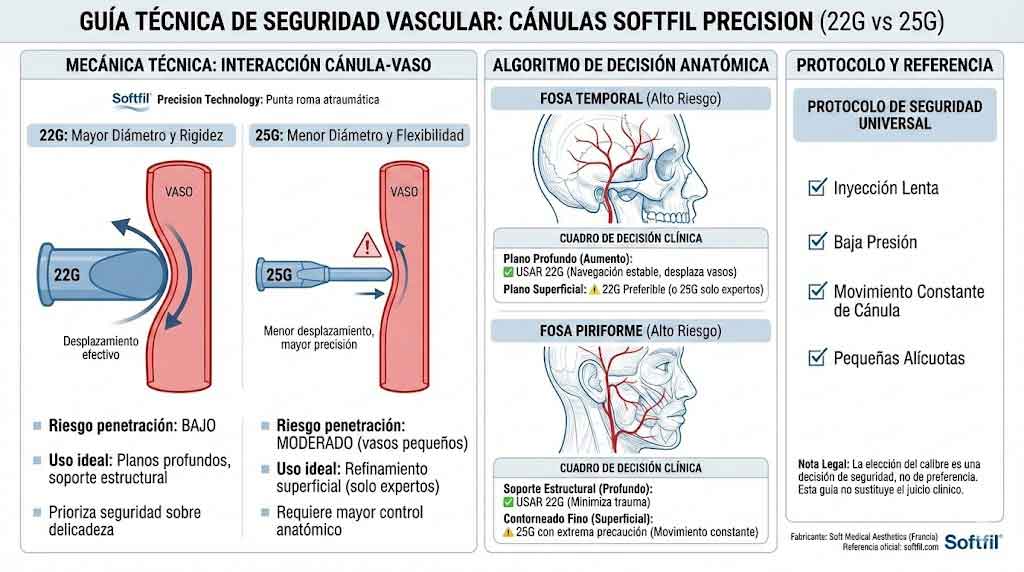
Softfil Cannula Guide for Preventing Vascular Complications in the Temple and Piriform Fossa
In aesthetic medicine, few complications carry the emotional and legal weight of vascular compromise. Blindness, skin necrosis or cerebral embolism are rare, but when they occur, they redefine how injectors approach safety.
For experienced practitioners, the discussion around cannulas is no longer about comfort or bruising. It is about risk reduction. Choosing the correct cannula—its gauge, length and flexibility—has become a critical safety decision, especially in high-risk anatomical areas such as the temporal fossa and the piriform fossa.
This is precisely where the Softfil cannula guide becomes clinically relevant. Softfil Precision cannulas are widely used, but many injectors still underestimate how gauge selection (22G vs 25G) directly influences vascular safety.
Why cannula choice matters more than ever
The expansion of filler indications into deeper and more vascularized regions has increased the importance of injection tools.
Needles still have a role, but cannulas offer:
- Reduced vessel penetration risk
- Lower likelihood of intravascular injection
- Safer navigation through complex anatomy
- Improved control in deep planes
However, not all cannulas behave the same way. Gauge selection directly affects:
- Vessel displacement vs penetration
- Injection pressure
- Precision vs safety balance
High-risk zones: temporal fossa and piriform fossa
Temporal fossa: anatomy and danger
The temporal region contains:
- Superficial temporal artery and vein
- Deep temporal arteries
- Anastomoses with ophthalmic circulation
Even small intravascular events here can result in:
- Visual impairment
- Skin necrosis
- Cerebral complications
The risk is compounded by:
- Thin soft tissue layers
- Deep bony planes
- High vascular density
Piriform fossa: underestimated but dangerous
The piriform fossa sits close to:
- Angular artery
- Facial artery branches
- Anastomoses with the dorsal nasal artery
Complications in this area are strongly associated with:
- Skin necrosis
- Retrograde embolization
- Visual complications
For this reason, tool selection is as important as anatomical knowledge.
Cannula gauge: what 22G and 25G really mean in practice
Understanding gauge mechanics
- 22G cannula
- Larger diameter
- Higher rigidity
- Greater vessel displacement capacity
- Lower risk of vessel penetration
- 25G cannula
- Smaller diameter
- Higher flexibility
- Greater precision
- Slightly increased penetration risk in small vessels
Gauge is not about comfort—it is about mechanical interaction with blood vessels.
Softfil Precision cannulas: design for vascular safety
Softfil Precision cannulas are engineered with:
- Blunt atraumatic tip
- Lateral port design
- High-quality stainless steel
- Balanced flexibility and control
Manufacturer: Soft Medical Aesthetics
Official source: https://softfil.com
These design features aim to reduce vessel trauma, but correct gauge selection remains essential.
22G vs 25G in the temporal fossa
Why 22G is often preferred
In the temporal region, safety outweighs finesse.
Advantages of 22G Softfil cannula:
- Better vessel displacement
- Lower risk of arterial penetration
- Stable navigation in deep planes
- Reduced injection pressure peaks
Clinical consensus increasingly supports 22G cannulas for deep temporal augmentation, particularly when using high G’ fillers.
When 25G may be acceptable
25G cannulas may be considered:
- In superficial temporal corrections
- For experienced injectors only
- With low-viscosity fillers
- In patients with favorable anatomy
However, the margin for error is smaller.
22G vs 25G in the piriform fossa
Piriform fossa: precision vs safety
The piriform fossa demands:
- Accurate placement
- Controlled volume
- Minimal vascular disturbance
22G advantages:
- Reduced risk of arterial entry
- Better vessel displacement
25G advantages:
- Greater precision
- Easier navigation in tight spaces
Many experts favor 22G for deep structural support, switching to 25G only for superficial refinement.
Cannula vs needle: the safety debate revisited
While cannulas are not risk-free, evidence suggests:
- Lower incidence of vascular occlusion
- Reduced embolic events
- Less bruising and swelling
In high-risk zones, cannula use is a safety standard, not an option.
Injection technique: cannula alone is not enough
Even the safest cannula cannot compensate for poor technique.
Key principles:
- Aspiration awareness (limited reliability)
- Slow injection
- Low pressure
- Continuous cannula movement
- Small aliquots
Cannulas reduce risk—they do not eliminate it.
Why this topic drives high search volume
From an SEO perspective, this topic performs well because:
- Cannula size is a frequent clinical doubt
- Safety-related searches have high intent
- Fear-based queries (blindness, necrosis) drive engagement
- Practitioners seek concrete guidance, not theory
Searches such as “cannula size for temporal filler” or “Softfil cannula guide” reflect real clinical anxiety and decision-making.
Clinical algorithms: simplifying cannula selection
Temporal fossa
- Deep plane → 22G Softfil Precision
- Superficial plane → 22G or 25G (expert only)
Piriform fossa
- Structural support → 22G
- Fine contouring → 25G with caution
Risk management and medico-legal protection
Using cannulas appropriately:
- Reduces complication rates
- Strengthens informed consent
- Supports defensible clinical practice
- Aligns with current safety recommendations
In medico-legal cases, tool choice matters.
Conclusion: gauge selection is a safety decision, not a preference
The debate around 22G vs 25G cannulas should not focus on injector comfort or habit.
In high-risk areas such as the temporal and piriform fossae:
- Larger gauge cannulas offer greater vascular safety
- Softfil Precision cannulas provide reliable design
- Proper selection significantly reduces embolic risk
Understanding and applying a Softfil cannula guide is not only good practice—it is a responsibility.
Softfil Precision Cannulas: Gauge, Length and Clinical Indications
| Softfil Cannula | Gauge / Length | Primary Clinical Use | Recommended Areas | Safety Rationale |
|---|---|---|---|---|
| Softfil Precision Micro-Cannula | 25G / 50 mm | Fine volumization and superficial corrections | Tear trough (selected cases), lips, superficial midface | Higher flexibility allows precision in delicate areas, but requires experienced technique due to smaller diameter |
| Softfil® Precision Micro-Cannula (Kit) | 22G / 40 mm | Structural support and deep filler placement | Temporal fossa, piriform fossa, deep midface | Larger gauge improves vessel displacement and reduces risk of arterial penetration |
| Softfil® Precision Micro-Cannula (Kit) | 22G / 50 mm | Deep volumization in high-risk anatomical areas | Temporal fossa, jawline, deep cheek fat compartments | Increased length allows safer access to deep planes with improved vascular safety |
| Softfil® Precision Micro-Cannula (Kit) | 25G / 40 mm | Controlled superficial contouring | Nasolabial folds, lips, superficial midface | Smaller gauge offers precision, but with a narrower safety margin in vascular areas |
Official sources and references
- Softfil Precision Cannulas – Soft Medical Aesthetics
https://softfil.com
All injection decisions should be based on individual anatomical assessment, clinical experience and current safety guidelines.