

1. Introduction: Understanding the Third Titan in HA Fillers
In aesthetic medicine, the conversation around hyaluronic acid (HA) fillers often focuses on the two dominant technologies — BDDE-crosslinked volumizers (e.g., Juvéderm®, Restylane®) and bioremodeling HA systems (e.g., Profhilo®).
However, a third technological pillar has progressively gained traction among medical professionals: Belotero CPM Technology, the Cohesive Polydensified Matrix (CPM®) system developed by Merz Aesthetics for the Belotero® range.
This innovative HA structure is not about maximum lift or stimulation — but about seamless tissue integration, rheological balance, and superior adaptability across dermal planes.
2. The Science of Rheology in Dermal Fillers
Rheology — the study of how a gel deforms under stress — determines a filler’s behavior inside tissue. For practitioners, this translates into tactile and visual outcomes: spreadability, lift, cohesivity, and tissue blending.
Key rheological parameters include:
- G’ (elastic modulus): resistance to deformation (lift capacity).
- G” (viscous modulus): capacity to flow and spread.
- Tan δ (delta): the ratio G”/G’, describing how elastic or viscous a gel behaves.
- Cohesivity: internal bonding strength; determines integration and resistance to migration.
Understanding these elements allows professionals to select fillers by indication, rather than only by brand or concentration.
3. The CPM® Technology: Cohesive Polydensified Matrix Explained
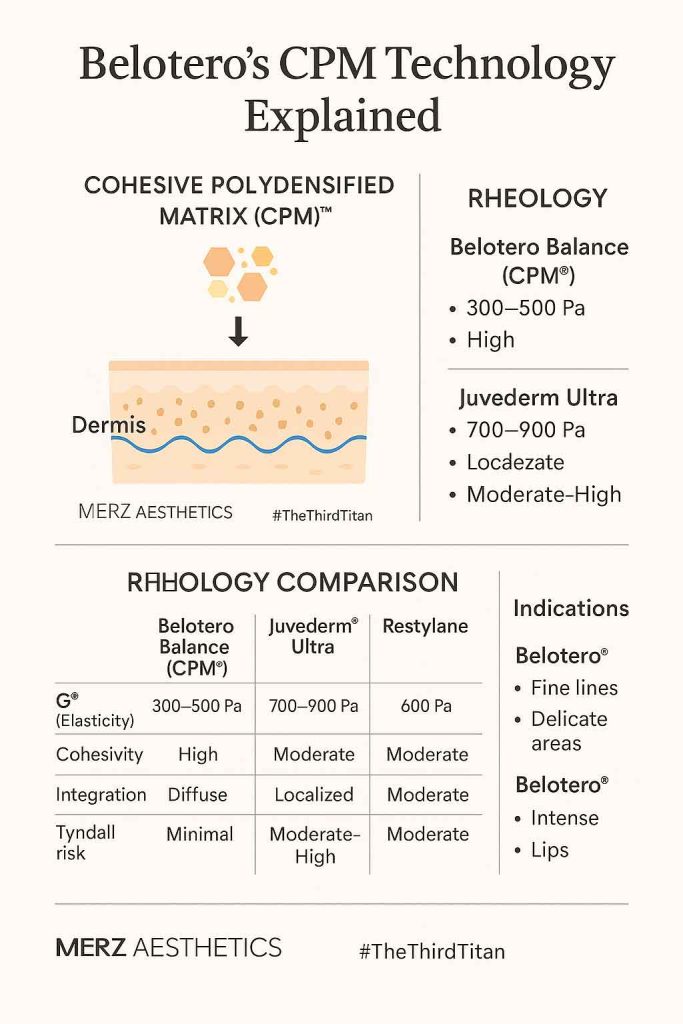
Unlike homogeneous or biphasic gels, Belotero® uses CPM® technology, which creates a polydensified HA network — regions of varying crosslinking density within a single gel.
This design ensures that the filler behaves differently depending on tissue resistance.
- Superficial layers (low density zones): allow smooth diffusion, preventing Tyndall effect.
- Deeper layers (high density zones): provide structure and subtle projection.
This dual-density concept results in continuous integration without palpable borders, a hallmark of Belotero’s performance.
Reference:
Merz Aesthetics. “The Science of CPM® Technology.” Merz Institute of Advanced Aesthetics. https://www.merz.com
4. Comparative Rheology: Belotero vs. Traditional Fillers
| Parameter | Belotero Balance (CPM®) | Juvederm Ultra | Restylane Classic |
|---|---|---|---|
| G’ (Elastic modulus) | 300–500 Pa | ~700–900 Pa | ~600 Pa |
| Cohesivity | High | Moderate | Moderate |
| Integration | Uniform, smooth | Localized, volumizing | Moderate |
| Tyndall risk (superficial) | Minimal | Moderate–High | Moderate |
| Injection plane versatility | Dermal–mid | Mid–deep | Mid |
Interpretation:
While Juvéderm® offers strong lift due to higher elasticity, Belotero Balance excels in fine-line correction, dermal uniformity, and natural transitions — making it preferred for perioral, periorbital, and superficial rejuvenation zones.
5. Belotero Range Breakdown: Soft, Balance, and Intense
Belotero® Soft
- HA concentration: 20 mg/ml
- Indications: fine lines, perioral wrinkles, delicate skin
- Injection depth: superficial dermis
- Key feature: highest spreadability and hydration effect
Belotero® Balance
- HA concentration: 22.5 mg/ml
- Indications: moderate wrinkles, nasolabial folds, tear trough
- Injection depth: superficial to mid-dermis
- Key feature: benchmark for natural expression retention
Belotero® Intense
- HA concentration: 25 mg/ml
- Indications: deep folds, lips, marionette lines
- Injection depth: mid to deep dermis
- Key feature: high elasticity with preserved cohesivity, ideal for volumetric correction without stiffness
Scientific Reference:
Hunecke, A., & Merz Pharmaceuticals GmbH. Rheological properties and tissue integration of CPM®-based hyaluronic acid fillers. Merz Technical Paper, 2022.
https://www.merzaesthetics.com
6. Clinical Implications: Integration vs. Projection
The Belotero family is engineered for integration over projection.
Its cohesive polydensified matrix distributes evenly in tissue, minimizing irregularities even in thin dermal areas — a contrast to the higher G’ volumizers used for contouring.
Ideal clinical applications:
- Perioral fine lines (Soft)
- Nasolabial folds and glabellar areas (Balance)
- Deep folds and volumization with natural mobility (Intense)
Such adaptability allows practitioners to combine different densities in one session, achieving multilayer correction while maintaining facial dynamics.
7. Belotero Balance vs. Juvéderm Ultra: The Rheological Debate
When comparing Belotero Balance vs. Juvéderm Ultra, professionals should focus on rheological intent rather than brand hierarchy:
| Parameter | Belotero Balance | Juvéderm Ultra |
|---|---|---|
| Technology | CPM® (monophasic polydensified) | Hylacross™ (monophasic homogeneous) |
| Crosslinker | BDDE | BDDE |
| G’ (elasticity) | Moderate | High |
| Integration | Diffuse, natural | Localized, lifting |
| Ideal use | Dynamic lines, dermal uniformity | Volume, contour definition |
Key insight: Belotero provides dermal harmony and texture improvement, whereas Juvéderm is suited for volumetric definition.
Both remain clinically valuable, depending on indication and patient phenotype.
8. Clinical Evidence and Safety
Belotero fillers demonstrate high biocompatibility, minimal swelling, and predictable integration.
In clinical studies, adverse events (erythema, edema, nodules) are transient and self-limited.
The lower extrusion force and high cohesivity support smoother injection dynamics and consistent outcomes.
Source:
De Boulle K. Hyaluronic acid soft-tissue fillers: A review of product characteristics and injection techniques. Aesthetic Plast Surg. 2013;37(4):587–600.
https://link.springer.com/article/10.1007/s00266-013-0121-1
9. Conclusion: The Rheological Signature of Belotero
Belotero’s CPM® technology represents a distinct rheological evolution in HA filler science.
By combining variable crosslink densities within a cohesive structure, it achieves exceptional tissue integration and natural expressivity — making it an essential tool in the professional’s portfolio.
For clinicians prioritizing texture refinement, soft tissue blending, and safety in dynamic zones, the Belotero range offers precision unmatched by more rigid volumizers.
References
- Merz Aesthetics – The Science Behind CPM® Technology: https://www.merz.com
- De Boulle K. Hyaluronic acid soft-tissue fillers. Aesthetic Plast Surg. https://link.springer.com/article/10.1007/s00266-013-0121-1
- Merz Institute of Advanced Aesthetics – Technical Papers on Belotero®: https://www.merzaesthetics.com