
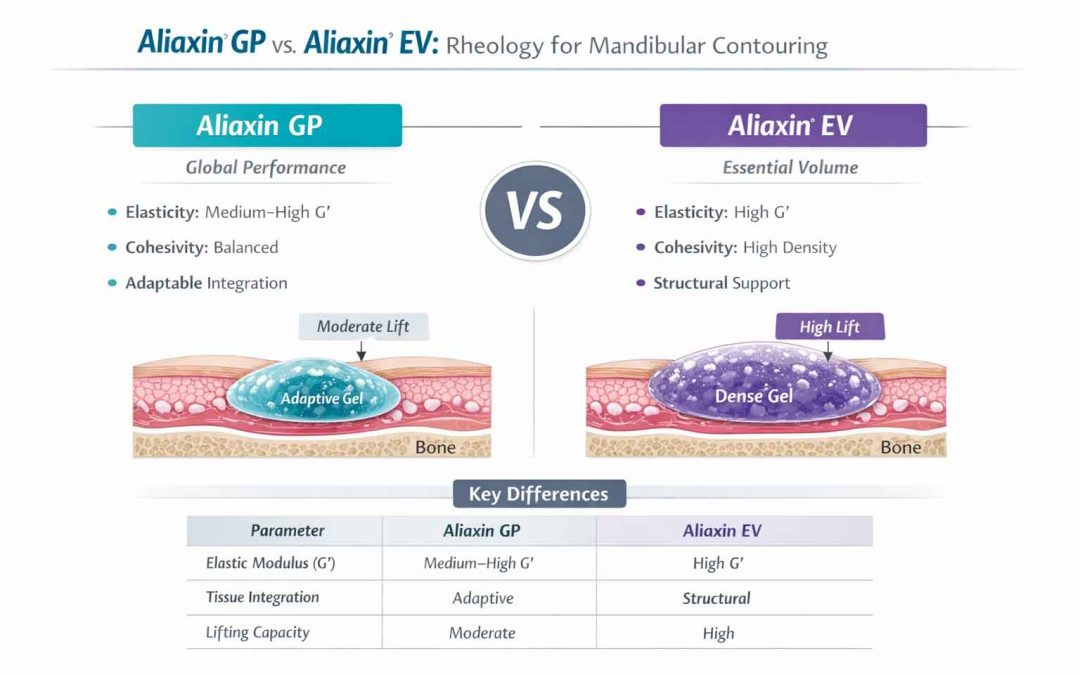
How Global Performance and Essential Volume Behave Differently in Jawline Projection
Aliaxin GP vs EV is a recurring question in modern mandibular contouring. Jawline treatments have evolved far beyond simple volume replacement and are now expected to deliver definition, projection, and stability under dynamic load, while maintaining natural tissue integration and long-term predictability.
For experienced injectors, the challenge is no longer whether to treat the jawline, but which rheological profile best matches the anatomical and biomechanical demands of each patient.
Within the Aliaxin range developed by IBSA, two products are frequently considered for mandibular work: Aliaxin Global Performance (GP) and Aliaxin Essential Volume (EV). Although they share the same brand and production philosophy, their rheological behavior, lifting capacity, and tissue integration differ in clinically meaningful ways.
Understanding these differences is essential for precise jawline profiling.
Why rheology matters in mandibular contouring
The mandibular area is a high-load, high-mobility zone. Fillers placed here must withstand:
- Continuous muscular activity (platysma, depressors)
- Mechanical pressure from overlying tissues
- Gravitational forces
- Repeated facial movement
As a result, rheology, not just HA concentration, becomes the key decision factor.
The most relevant rheological parameters for jawline work include:
- Elastic modulus (G′)
- Cohesivity
- Gel homogeneity
- Tissue integration dynamics
The Aliaxin philosophy: balanced HA technology
Aliaxin fillers are produced using IBSA’s proprietary HA technology, characterized by:
- High-purity hyaluronic acid
- Thermal crosslinking processes
- Balanced viscoelastic properties
- Emphasis on tissue integration rather than excessive stiffness
This philosophy is consistent across the range, but each product is tuned for a specific mechanical role.
Aliaxin GP: Global Performance for adaptive structural support
Aliaxin GP (Global Performance) is designed as a multi-purpose filler capable of adapting to different facial dynamics.
Key rheological characteristics
- Medium–high G′
- Balanced cohesivity
- High adaptability under dynamic stress
- Smooth tissue integration
Clinically, this translates into a filler that:
- Provides visible support
- Adapts well to movement
- Integrates progressively into surrounding tissues
In the mandibular region, Aliaxin GP is particularly useful when:
- The goal is definition with flexibility
- The patient has thinner tissues
- Overly rigid projection could appear unnatural
Aliaxin EV: Essential Volume for maximum lift and projection
Aliaxin EV (Essential Volume) is positioned at the higher end of the lifting spectrum within the Aliaxin portfolio.
Key rheological characteristics
- Higher G′ compared to GP
- Stronger lifting capacity
- Higher resistance to deformation
- More pronounced structural behavior
In jawline contouring, Aliaxin EV excels when:
- Clear angular definition is required
- The patient has thicker tissues or volume loss
- Structural support must resist downward forces
EV behaves more like a scaffold, maintaining projection even under significant mechanical load.
Tissue integration: dynamic vs structural behavior
One of the most relevant differences between GP and EV is how they integrate into tissue over time.
- Aliaxin GP integrates more dynamically, blending with surrounding tissues and adapting to movement.
- Aliaxin EV maintains a more defined structural presence, preserving contour and angles.
This distinction is critical in mandibular profiling, where over-integration can soften definition, while under-integration can feel unnatural.
Table — Aliaxin GP vs. EV for mandibular contouring
| Parameter | Aliaxin GP | Aliaxin EV |
|---|---|---|
| Primary role | Adaptive support | Structural volume |
| G′ (elastic modulus) | Medium–high | High |
| Lifting capacity | Moderate–high | High |
| Deformation resistance | Balanced | Strong |
| Tissue integration | Progressive, dynamic | Structural, stable |
| Ideal jawline indication | Natural definition, flexibility | Strong projection, angular contour |
Clinical decision-making: when to choose GP vs. EV
Choose Aliaxin GP when:
- The patient requires subtle jawline definition
- Tissues are thin or mobile
- Natural movement is a priority
- You want gradual integration without rigidity
Choose Aliaxin EV when:
- Clear mandibular angles are needed
- There is significant volume deficiency
- The patient requests a sharper contour
- Structural lift is the main objective
In some cases, combining both products in different planes can provide optimal results.
Injection depth and technique considerations
Regardless of product choice, correct placement is essential.
- Aliaxin EV performs best in deep supraperiosteal planes for structural support.
- Aliaxin GP can be used slightly more superficially to refine contours and transitions.
Using the wrong product at the wrong depth often explains suboptimal outcomes—not the filler itself.
Practical takeaway for experienced injectors
Aliaxin GP and Aliaxin EV are not interchangeable. They are complementary tools designed for different biomechanical roles.
- GP offers adaptive support and integration
- EV provides maximum lift and projection
Selecting the correct product based on rheology and tissue behavior is what separates routine jawline treatments from consistently high-level outcomes.
Official sources and reference documentation
The clinical and rheological considerations discussed in this article are based on official manufacturer information and publicly available scientific documentation. Aliaxin GP and Aliaxin EV are developed by IBSA (Institut Biochimique SA), a pharmaceutical company with extensive experience in hyaluronic acid research and injectable medical devices. Data regarding Aliaxin’s hyaluronic acid production process, rheological behavior, tissue integration, and clinical indications can be consulted in the following official sources:
- IBSA official website (Aesthetic Medicine Division):
https://www.ibsa.it - Aliaxin product range overview (manufacturer):
https://www.ibsa.it/aliaxin - IBSA Aesthetic Medicine international site:
https://www.ibsaderma.com - Aliaxin scientific and product documentation (professional access):
https://www.ibsaderma.com/products/aliaxin
Clinicians are encouraged to review the most up-to-date official documentation and regulatory-approved materials and to integrate this information with anatomical knowledge, injection technique, and individual patient assessment when selecting fillers for mandibular contouring.