
In aesthetic medicine, one of the most significant shifts of recent years has been the transition from volumizing correction to dermal function restoration.
Rather than simply filling or tightening, modern practitioners now aim to revitalize and regenerate the skin’s biology — to restore structure, hydration, and fibroblast function from within.
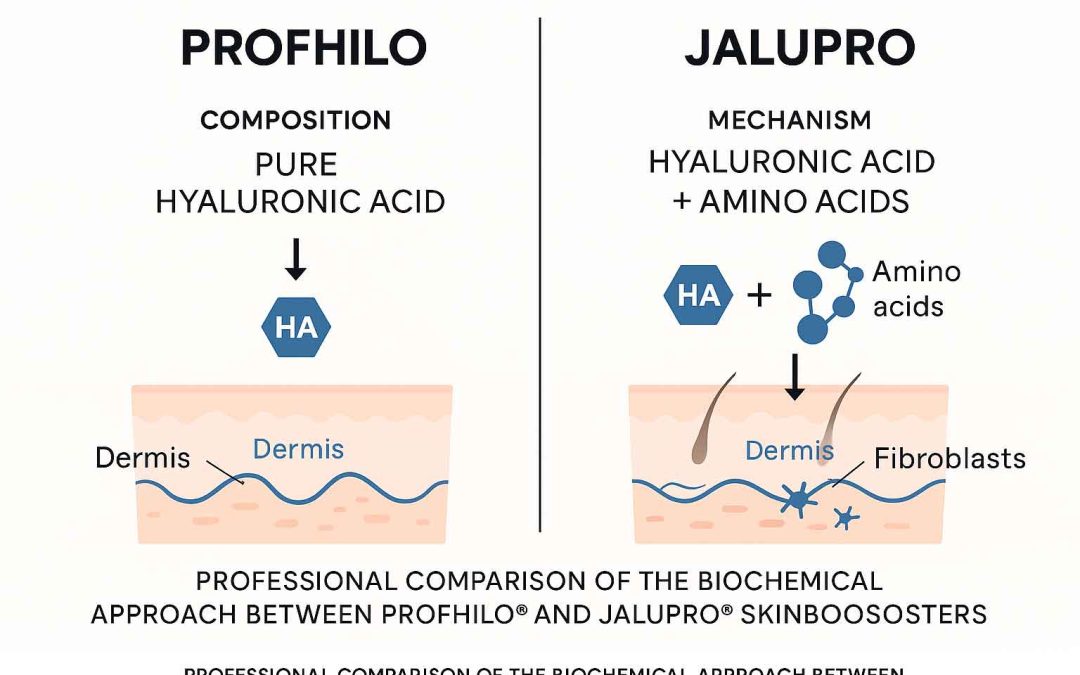
When discussing Profhilo vs Jalupro, two of the most recognized names among the new generation of skinboosters, it becomes clear that both share a commitment to skin regeneration yet follow different scientific paths.
Both are well-established, CE-certified injectables used worldwide, yet their formulations and clinical intentions differ substantially.
This article explores Profhilo vs Jalupro through a professional lens: composition, mechanism of action, patient selection, and clinical protocol — helping practitioners decide which suits each indication best.
1. The Rise of Skinboosters in Aesthetic Medicine
The term skinbooster describes injectable treatments that aim to improve skin quality rather than add volume.
They are placed superficially within the dermis to stimulate collagen, elastin, and extracellular matrix activity.
According to Clinical, Cosmetic and Investigational Dermatology (Dove Press), hyaluronic acid (HA) skin treatments enhance dermal density and hydration while upregulating type I collagen production — without affecting facial morphology.
Source: https://www.dovepress.com/articles.php?article_id=30859
The result is a more physiological, regenerative approach to anti-aging — one that supports tissue health, not just aesthetics.
2. Profhilo® — The Benchmark for Biorevitalization
Profhilo® (IBSA Derma, Switzerland) is considered a pioneer in what is now known as bioremodeling.
Unlike traditional HA fillers, it is designed to diffuse across tissue, remodel skin laxity, and enhance elasticity without altering facial shape.
Composition and Technology
- 64 mg of ultrapure hyaluronic acid (32 mg high molecular weight + 32 mg low molecular weight).
- Stabilized using IBSA’s proprietary NAHYCO® Hybrid Technology, without chemical crosslinkers (BDDE-free).
- Dual action: intense hydration and fibroblast stimulation for collagen and elastin production.
Clinical studies have shown significant improvements in skin elasticity, hydration, and firmness after just two sessions spaced four weeks apart.
Source: https://www.ibsaderma.com
Clinical Indications
- Mild to moderate laxity.
- Dull or thin skin with decreased firmness.
- Face, neck, décolleté, and hands.
Advantages
- Excellent tissue integration and biocompatibility.
- Simple 10-point BAP injection technique.
- Subtle yet visible improvement in texture and radiance.
Reference: Brazilian Aesthetic Journal (2022). Clinical evaluation of hybrid HA complexes in dermal bioremodeling.
https://www.ibsaderma.com/science
3. Jalupro® — The Regenerative Approach with Amino Acids
Jalupro® (Professional Derma SA, Switzerland) takes a complementary yet distinct approach.
It acts as a nutrient-rich dermal bioregeneration system, combining hyaluronic acid with a complex of amino acids essential for fibroblast metabolism.
Formulations
- Jalupro Classic: for younger or mildly photoaged skin.
- Jalupro HMW: higher molecular weight HA for more damaged or mature skin.
- Jalupro Super Hydro: advanced peptide-enriched formula with multimolecular HA.
Source: https://md.jalupro.com
Mechanism of Action
- Provides metabolic substrates (glycine, proline, lysine, leucine) required for collagen and elastin synthesis.
- The HA component enhances hydration and supports extracellular matrix repair.
- Designed for both biorevitalization and bioregeneration of aged or stressed skin.
Clinical Indications
- Photoaged, dull, or atrophic skin.
- Moderate to advanced laxity.
- Useful on face, neck, décolleté, and body areas such as arms, abdomen, and knees.
Advantages
- Restores fibroblast function and dermal metabolism.
- Suitable for combination protocols (microneedling, laser, PRP).
- Visible progressive results over several sessions.
Reference: Professional Derma SA — Jalupro Clinical Dossier 2024.
https://www.professionalderma.com
4. Biorevitalization vs. Bioregeneration: Understanding the Difference
While both products are injectable HA-based boosters, their biological intentions diverge.
| Parameter | Profhilo® | Jalupro® |
|---|---|---|
| Primary action | Biorevitalization (hydration and elasticity) | Bioregeneration (fibroblast stimulation) |
| Key components | Pure hybrid HA (NAHYCO®) | HA + amino acids complex |
| Main effect | Restores hydration and firmness | Stimulates collagen and extracellular matrix |
| Best for | Fine skin, mild laxity | Photoaging, visible damage, atrophy |
| Typical protocol | 2 sessions, 4 weeks apart | 3–4 sessions, 2–3 weeks apart |
Rather than competing, they can coexist in clinical practice:
For example, Jalupro® may be used first for dermal repair, followed by Profhilo® for long-term hydration and remodeling.
5. Clinical Protocols and Treatment Frequency
Profhilo®
- Two sessions, one month apart; maintenance every 6–9 months.
- Injected using the BAP (Bio Aesthetic Points) technique for optimal diffusion.
- Minimal downtime, suitable for face, neck, and hands.
Jalupro®
- Three to four sessions, every 15–20 days, depending on the degree of aging.
- Often combined with microneedling or RF to potentiate fibroblast activity.
- Maintenance recommended every 4–6 months.
Reference: Jalupro Professional Training Guide — Clinical Application Protocols 2023.
https://md.jalupro.com
6. Safety, Efficacy, and Patient Tolerance
Both products are CE-certified, sterile, and biocompatible.
They are designed exclusively for injection by qualified medical professionals.
Reported side effects are minimal — transient erythema, mild edema, or small hematomas resolving within 24–48 hours.
Contraindications
- Pregnancy or breastfeeding.
- Active skin infection or inflammation.
- Autoimmune conditions or impaired wound healing.
Clinical outcomes depend on technique, patient lifestyle, and dermal baseline.
Proper patient selection and realistic counseling remain essential for consistent results.
7. When to Choose Each Product
Choose Profhilo® when:
- The patient presents mild laxity, thin or dehydrated skin.
- The objective is biorevitalization and dermal remodeling without volumizing.
- You need a fast, minimally invasive protocol with natural outcomes.
Choose Jalupro® when:
- The patient exhibits deeper dermal fatigue, photoaging, or fine wrinkles.
- Regenerative stimulation and amino acid replenishment are desired.
- You plan to combine with other regenerative modalities (PRP, laser, microneedling).
Sequential approach:
Many aesthetic physicians combine both within the same treatment cycle —
using Jalupro® for regeneration and Profhilo® for revitalization and maintenance.
8. Clinical Insight: Function Before Volume
The discussion around Profhilo vs Jalupro is not about superiority but about indication and biological target.
Profhilo® enhances skin function and structure through hydration and collagen activation.
Jalupro® focuses on metabolic recovery and fibroblast support through amino acid delivery.
As aesthetic medicine evolves, the emphasis shifts toward functional rejuvenation —
treatments that optimize dermal physiology, not just cosmetic appearance.
“Skin doesn’t need more volume. It needs better function.”
— Dr. P. Casabona, Dermatologic Aesthetic Symposium 2023.
References
- IBSA Derma — Profhilo® NAHYCO® Hybrid Technology Overview
https://www.ibsaderma.com - Professional Derma SA — Jalupro® Clinical Information and Data
https://www.professionalderma.com - Jalupro Medical Website — Product Portfolio & Mechanism of Action
https://md.jalupro.com - Clinical, Cosmetic and Investigational Dermatology (Dove Press, 2022).
“Hyaluronic Acid–Based Biorevitalization and Collagen Stimulation in Aging Skin.”
https://www.dovepress.com/articles.php?article_id=30859 - Brazilian Aesthetic Journal (2022) — Hybrid Hyaluronic Acid in Bioremodeling.
https://www.ibsaderma.com/science