
As aesthetic medicine professionals, our choice of a hyaluronic acid (HA) filler has evolved far beyond simple volume correction or a decision based purely on cost-per-syringe. We are now operating in a highly sophisticated field where we demand unwavering predictability, maximized safety across challenging and anatomically distinct injection planes, and, increasingly, sophisticated outcomes that authentically respect and integrate with natural facial dynamics. This is why a deep, rheological understanding of specific manufacturing platforms, such as the Belotero CPM Technology, is no longer optional but fundamental to our clinical decision-making.
In the competitive HA filler landscape, where rheology is the determining variable, the Belotero portfolio (Merz Aesthetics) has solidified its position not by competing on maximum projection (high G’), but on a more subtle and clinically crucial attribute: tissue integration.
The pillar of this philosophy is the Cohesive Polydensified Matrix (CPM)®, a manufacturing technology that yields a product with unique rheological behavior. This analysis delves into why CPM behaves differently in vivo and how to apply this understanding in our daily practic
Deconstructing CPM Technology: Beyond Monophasic
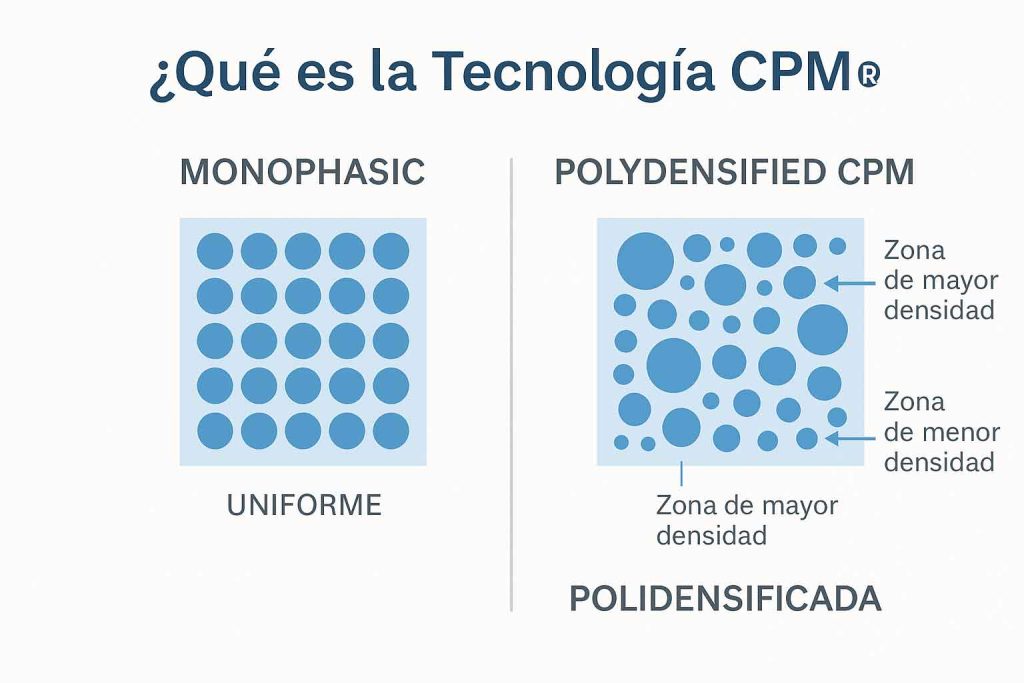
Unlike homogenous monophasic technologies (e.g., Juvederm’s Hylacross) or particulated biphasic ones (e.g., Restylane’s NASHA), CPM is a cohesive monophasic gel, yet rheologically unique: it is polydensified.
This patented dynamic cross-linking process generates a continuum of densities within the same HA matrix. The final gel possesses zones of higher cross-linking (higher density) that provide support, and zones of lower cross-linking (lower density).
Clinical Translation: In practice, this translates to a smooth extrusion from the needle (low extrusion force) and a unique ability for the gel to flow and adapt to the interstitial spaces of the dermis, rather than simply “pushing” tissue or becoming encapsulated. It maintains high cohesivity but with an adaptive fluidity.
The Rheological Profile in Clinical Practice
Rheology is not just lab theory; it defines the aesthetic result and the patient’s tactile sensation. The CPM profile excels in three key areas:
- High Cohesivity: Cohesivity is the gel’s ability to “stick together” and resist fragmentation. The high cohesivity of CPM is vital in high-mobility areas (e.g., perioral). The gel integrates but does not disperse or migrate under the mechanical stress of facial mimicry.
- Balance of G’ (Elasticity) / G” (Viscosity): Belotero’s rheological profile tends to show a lower G’ (elastic modulus) and a higher G” (viscous modulus) compared to competitors designed for high projection. It is not primarily designed to “lift” tissue with stiffness (high G’), but to “integrate” and move with it (high fluidity and cohesivity).
- The Tyndall Effect Challenge: This is where CPM demonstrates its clinical superiority. Its capacity for homogenous integration into the dermis, thanks to the polydensified matrix, allows us to perform very superficial dermal injections. This dramatically minimizes the risk of the Tyndall effect (bluish discoloration) that we observe with stiffer or particulated gels in superficial planes.
Product Selection: Clinical Application of CPM Rheology
The CPM technology is adjusted to create a portfolio where each product has a clear rheological objective.
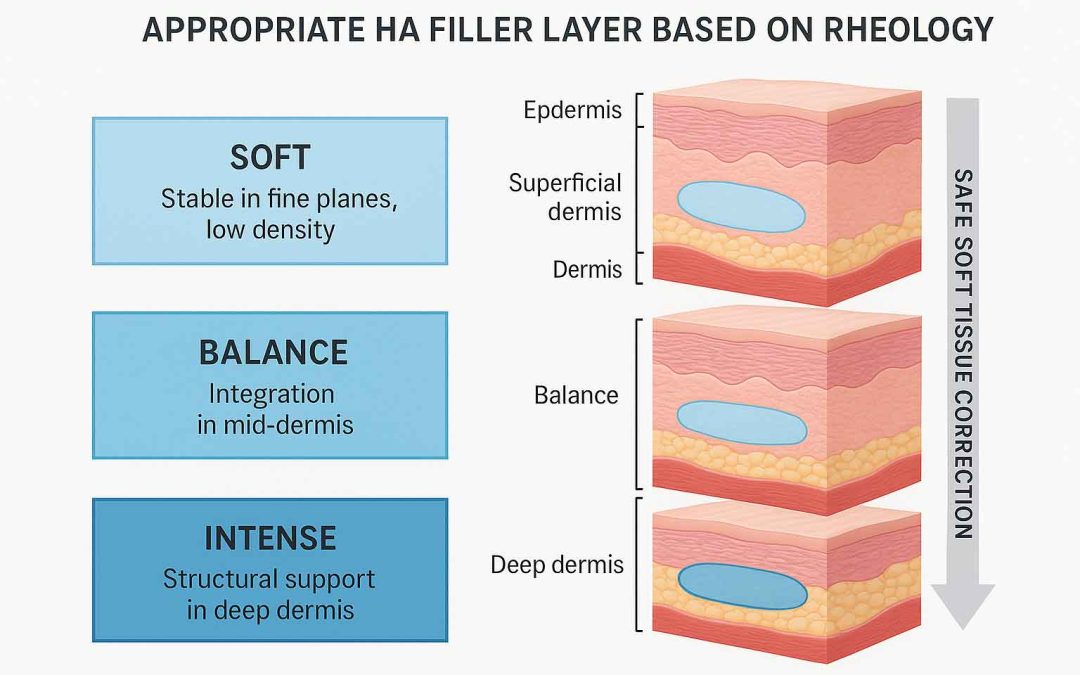
Belotero Soft
This is our precision tool for the superficial dermis.
- Rheology: Very low viscosity, optimized for fluidity.
- Clinical Application: It is the undisputed product of choice for the blanching technique. We use it for fine perioral lines, superficial crow’s feet, and fine cheek wrinkles (“accordion lines”), where any other product would create a palpable or visible ridge.
Belotero Balance
This is the portfolio’s gold standard for dermal integration.
- Rheology: The perfect equilibrium between cohesivity and integration.
- Clinical Application: This is the product we select for moderate nasolabial folds (NLFs), marionette lines, and defining the vermilion border. Its great advantage is providing natural correction in patients who need dermal treatment without “feeling” the filler.
Professional Comparison: Belotero Balance vs. Juvederm Ultra
This is a common technical comparison. They are not interchangeable products:
- Juvederm Ultra (Hylacross): Offers a higher G’ and a greater “filling” or push capacity. It is excellent for delivering volume and a more robust correction in moderate-to-severe folds.
- Belotero Balance (CPM): Its strength is integration. If the injection plane is superficial or the patient has thin skin, Balance offers a much greater margin of safety against irregularities and visibility.
Belotero Intense
Used when we need structural support without sacrificing integration.
- Rheology: Maintains CPM’s cohesivity but with a higher G’ than Balance for greater support.
- Clinical Application: We use this for deep folds (severe NLFs, pronounced marionette lines) and for lip augmentation when an integrated, soft result with definition is desired.
Professional Conclusion
Belotero’s CPM technology forces us as injectors to think beyond G’ (stiffness) as the sole measure of a filler. It offers us a portfolio whose primary attribute is tissue adaptation.
In a clinical era where patients demand undetectable and dynamic results, a filler’s ability to integrate and move with the tissue, rather than simply occupying space, is the true differentiator. Belotero provides us with the precise tools to treat the superficial and mid-dermis with a confidence that other, rheologically different, gels do not permit.
Official Information Sources and References
As professionals, it is our responsibility to base our practice on evidence and manufacturer data. Below are official resources for further consultation:
- Merz Aesthetics (Professional Portal): The manufacturer provides the technical information, Summaries of Product Characteristics (SmPC), and clinical data for their filler portfolio.
- Global URL:
https://merz-aesthetics.com/products/belotero/
- Global URL:
- Key Publications on CPM Rheology: For a deep dive into the physical properties of HA fillers, comparative studies are fundamental. A key foundational paper is:
- Kablik, J., Monheit, G. D., Yu, L., Chang, G., & Gershkovich, J. (2009). Comparative physical properties of hyaluronic acid dermal fillers. Dermatologic surgery, 35 Suppl 1, 302–312. (This article compares the rheological properties, including Belotero—then known as Esthélis).
- URL (PubMed):
https://pubmed.ncbi.nlm.nih.gov/19261019/
- Regulatory Documentation (FDA): The FDA approval documentation for Belotero Balance (P090016) offers a detailed summary of the device’s safety, efficacy, and properties.
- URL (FDA Database):
https://www.accessdata.fda.gov/scripts/cdrh/cfdocs/cfpma/pma.cfm?id=P090016
- URL (FDA Database):
- Belotero (U.S. HCP Portal): Specific information for healthcare professionals in the US market, including injection guides and product data.