
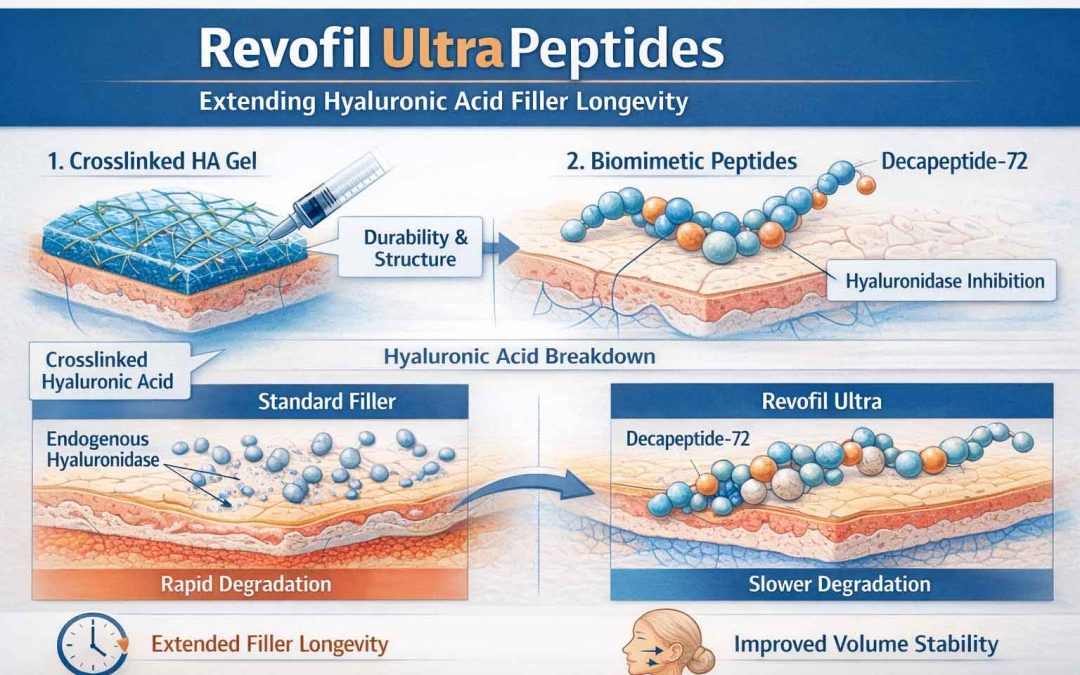
How Decapeptide-72–Based Technology Extends Hyaluronic Acid Longevity Beyond Crosslinking
When clinicians discuss long-lasting dermal fillers, the conversation almost always revolves around the same parameters: crosslinking density, HA concentration, and rheology. These factors undeniably matter. However, they only address one side of the degradation equation.
Hyaluronic acid does not disappear solely because a gel loses mechanical integrity. It is actively broken down by endogenous hyaluronidase enzymes present in the tissue. This biological reality has often been overlooked in filler design.
Revofil Ultra peptides introduce a different scientific approach: extending filler longevity not only through gel structure, but also through biomimetic peptide-based inhibition of endogenous hyaluronidase, with Decapeptide-72 cited in technical positioning as a key functional component.
For clinicians seeking true duration, predictability, and reduced variability between patients, this mechanism deserves closer examination.
Why “long-lasting fillers” often fail in real practice
From a clinical standpoint, early degradation of hyaluronic acid fillers is one of the most frustrating outcomes. Even with correct technique and appropriate product choice, some patients experience faster-than-expected volume loss.
Common explanations include:
- “Fast metabolizer”
- High facial mobility
- Active lifestyle
- Strong inflammatory response
While these factors play a role, they all converge on a single biological mechanism: accelerated enzymatic degradation of hyaluronic acid.
This is where classic filler design reaches its limit. Increasing crosslinking can improve mechanical resistance, but it does not directly address hyaluronidase activity within the tissue.
Revofil Ultra: a dual-mechanism concept
Revofil Ultra is positioned as a hyaluronic acid filler that combines:
- Crosslinked HA for mechanical stability
- Biomimetic peptides designed to reduce enzymatic breakdown
This dual approach targets both:
- The physical durability of the gel
- The biological environment in which it resides
From a scientific perspective, this is a more complete strategy for extending filler longevity.
Understanding endogenous hyaluronidase in aesthetic medicine
Hyaluronidases are enzymes naturally present in human tissue. Their physiological role is to regulate extracellular matrix turnover by breaking down hyaluronic acid.
In aesthetic injections, this means:
- Even well-crosslinked HA is continuously exposed to enzymatic degradation
- Duration is not purely a function of gel strength
- Local enzyme activity varies significantly between patients and anatomical regions
Clinically, this explains why two patients injected with the same product, volume, and technique may show very different longevity.
Biomimetic peptides as enzyme modulators
Biomimetic peptides are short amino-acid sequences designed to interact with specific biological pathways. In the case of Revofil Ultra, Decapeptide-72 is referenced in technical communication as a peptide associated with hyaluronidase inhibition.
The theoretical implication is straightforward:
- Reduced hyaluronidase activity
- Slower breakdown of injected HA
- More stable volume over time
This mechanism does not replace crosslinking; it complements it at a biochemical level.
Why this approach is fundamentally different
Most fillers rely exclusively on:
- Higher HA concentration
- Tighter crosslinking
- Increased gel stiffness
While effective, these strategies can introduce trade-offs:
- Increased palpability
- Reduced adaptability in dynamic areas
- Higher inflammatory potential
By contrast, enzymatic modulation aims to:
- Preserve HA without excessive stiffening
- Maintain natural tissue behavior
- Reduce variability in degradation speed
From a design standpoint, this is a more biologically elegant solution.
Clinical implications of hyaluronidase inhibition
If endogenous hyaluronidase activity is partially inhibited, the clinician may observe:
- More consistent duration across patients
- Fewer early touch-ups
- Improved predictability in structural areas
- Better long-term contour stability
This is particularly relevant in:
- Deep folds
- Structural contouring
- Areas where repeated reinjection increases risk or cost
Table 1 — Classic filler longevity vs peptide-supported longevity
| Approach | Primary mechanism | Strength | Limitation |
|---|---|---|---|
| High crosslinking | Mechanical resistance | Strong lift | Does not address enzymatic breakdown |
| Rheology optimization | Gel behavior | Natural movement | Still enzyme-dependent |
| Revofil Ultra approach | Crosslinking + enzyme inhibition | Extended stability | Clinical experience still essential |
Decapeptide-72: what clinicians should understand
It is important to remain precise and conservative in interpretation.
Decapeptide-72 is not:
- A pharmacological hyaluronidase blocker
- A guarantee of fixed duration
- A substitute for correct product indication
What it represents is a supportive biochemical strategy aimed at reducing one of the main causes of HA degradation.
For experienced injectors, this shifts the discussion from “stronger gels” to “smarter longevity”.
Where Revofil Ultra fits clinically
Based on its positioning and formulation logic, Revofil Ultra is conceptually suited for:
- Deep wrinkles and folds
- Structural support
- Areas where early degradation compromises outcomes
- Patients seeking fewer maintenance sessions
It should not be viewed as a universal solution, but rather as a tool for cases where enzymatic degradation is a known limiting factor.
Official sources and reference documentation
The information presented in this article is based on official manufacturer documentation and publicly available technical materials. Revofil Ultra is developed by Caregen Co., Ltd. (South Korea), a biotechnology laboratory specialized in biomimetic peptide research and injectable medical devices. Details regarding product composition, biomimetic peptides (including Decapeptide-72 / Oligopeptide-72, CG-Boostrin), and the proposed mechanism of hyaluronidase inhibition are available in the following official and distributor sources:
- Caregen official website: https://www.caregen.co.kr
- Revofil product overview (manufacturer): https://www.revofil.com
- Revofil Ultra technical leaflet (PDF): https://btcomedical.com/wp-content/uploads/2018/11/2015_REVOFIL_NEW_Leaflet_20150203-1-1.pdf
- Revofil catalog (Spanish, PDF): https://esteticanarias.com/wp-content/uploads/2016/12/Revofil-Catalogo-Castellano.pdf
- Distributor technical product page (example): https://www.directdermasupplies.com/products/revofil/revofil-ultra-1ml
Clinicians are encouraged to consult the latest official documentation and regulatory-approved materials and to integrate this information with their own clinical experience and patient-specific assessment when making treatment decisions.