
Unlocking the Power of Biomimetic Peptides: A Technical Deep-Dive into Targeted Fibroblast Activation and Dermal Redensification.
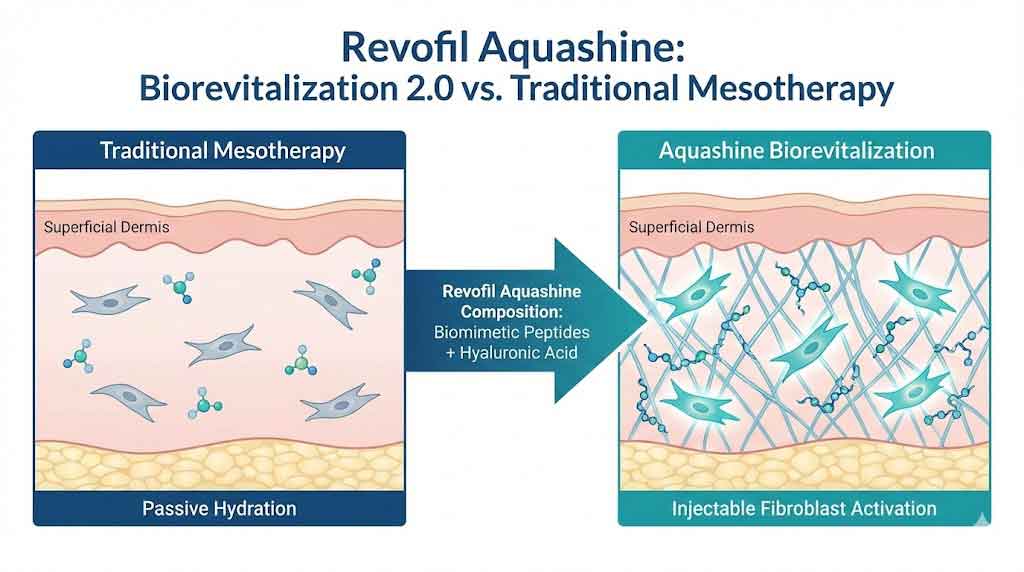
In the landscape of injectable biorevitalizers, the distinction between passive hydration and active cellular modulation has become the new frontier for aesthetic clinics. While traditional mesotherapy—primarily based on non-cross-linked hyaluronic acid and vitamin complexes—provides temporary radiance, Revofil Aquashine represents a paradigm shift toward biorevitalization 2.0. By integrating biomimetic peptides (synthetic growth factors), Aquashine does not just “feed” the skin; it “reprograms” the extracellular matrix by inducing direct injectable fibroblast activation.
To truly master this advanced technique, one must analyze the Revofil Aquashine composition, which functions as a molecular symphony rather than a simple nutrient cocktail. Unlike standard formulations that merely provide raw materials for the skin to use, the specific peptides within the Revofil Aquashine composition act as ligands that bind to cell surface receptors, triggering a sophisticated cascade of regenerative events. This “bio-instructive” approach ensures that the high-molecular-weight hyaluronic acid present in the gel does not just sit in the interstitial space but serves as a scaffold for newly synthesized collagen and elastin fibers.
Furthermore, the Revofil Aquashine composition addresses a common limitation in traditional mesotherapy: rapid enzymatic degradation. By including specialized oligopeptides that inhibit endogenous hyaluronidase activity, the product maintains its biostimulatory effect over a significantly longer physiological window. For the aesthetic practitioner, this translates to a more predictable increase in dermal thickness and a visible reduction in fine lines that vitamins alone simply cannot achieve. Understanding the biochemical nuances of the Revofil Aquashine composition is, therefore, the key to transitioning from superficial “glow” treatments to true, long-lasting dermal redensification that yields measurable patient satisfaction.
1. The Science of Composition: Peptides vs. Vitamins
The clinical superiority of Aquashine lies in its complex formulation. Unlike simple vitamin cocktails that rely on the presence of nutrients to support existing cell function, Aquashine uses high-tech peptides to signal the skin to regenerate.
The Three Pillars of Revofil Aquashine
- Non-Cross-Linked Hyaluronic Acid (1.5%): Provides immediate hydro-balance and a template for cellular migration.
- Biomimetic Peptide Complex: Specifically engineered sequences that mimic endogenous growth factors (e.g., Oligopeptide-34, Oligopeptide-72).
- Multivitamin and Amino Acid Cluster: A comprehensive blend of 14 vitamins, 24 amino acids, and 8 minerals/coenzymes that act as raw materials for new collagen synthesis.
2. Comparative Analysis: Aquashine vs. Standard Mesotherapy
For the aesthetic professional, understanding the “why” behind the results is essential for patient conversion.
| Feature | Standard Mesotherapy (NCTF/Others) | Revofil Aquashine |
| Primary Mechanism | Passive nutrient supplementation | Active Bio-modulation |
| Cellular Target | General skin nutrition | Specific Fibroblast Activation |
| Key Ingredient | Vitamins + Minerals + HA | Biomimetic Peptides + HA + Vitamins |
| Fibroblast Response | Limited to available nutrients | Upregulation of Collagen & Elastin mRNA |
| Clinical Focus | Brightness and hydration | Redensification and Tissue Remodeling |
| Result Longevity | Short-term (Days/Weeks) | Cumulative and Structural (Months) |
3. Mechanism of Action: Injectable Fibroblast Activation
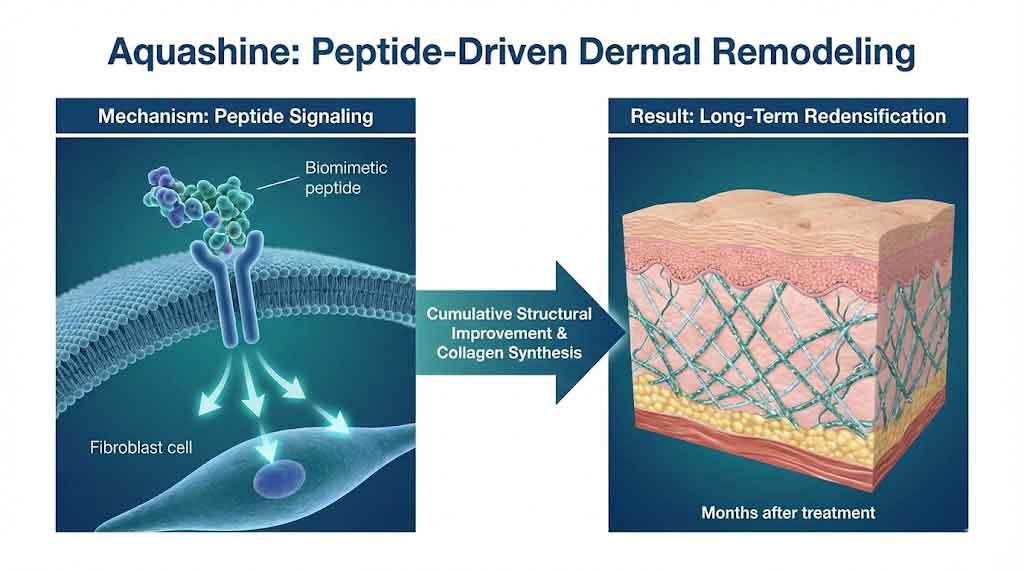
The “secret sauce” of the Revofil Aquashine composition is the specific action of its peptides on the TGF-$\beta$ (Transforming Growth Factor beta) pathways.
- Oligopeptide-72 (Boost): Inhibits endogenous hyaluronidase, significantly slowing down the degradation of both the injected and the natural HA.
- Oligopeptide-34 (Brightening): Downregulates melanin synthesis by inhibiting the MITF (Microphthalmia-associated transcription factor) pathway, addressing dermal dullness from a cellular level.
- Decapeptide-3 & Oligopeptide-24: These peptides act as powerful fibroblast stimulators, increasing the production of Type I collagen and elastin fibers.
Clinical Insight: In advanced mesotherapy, the goal is to shift the skin from a catabolic state to an anabolic state. Aquashine achieves this by providing the signaling molecules (peptides) and the metabolic fuel (vitamins/minerals) simultaneously.
4. Clinical Protocol for Maximum Redensification
To achieve the best results in tissue redensification, the following protocol is recommended for aesthetic clinics:
- Technique: Point-by-point (papule) or micro-retrograde injections.
- Depth: Mid-dermis (to ensure peptide-fibroblast interaction).
- Session Frequency: 3 sessions spaced 4 weeks apart.
- Maintenance: One session every 4-6 months to maintain cellular “memory” and protein production levels.
5. Official Sources and Technical Documentation
For medical directors and clinicians looking for peer-reviewed data and official manufacturer specifications:
- Caregen Official (Manufacturer): Biomimetic Peptide Technology and Revofil Portfolio
- Clinical Study on Peptides in Aesthetic Medicine: Journal of Cosmetic and Laser Therapy – Bio-remodelling with Peptides (Search for: Biomimetic peptides in dermal fillers).
- Product Safety and CE Marking: Detailed technical sheets are available through authorized regional distributors (e.g., Revofil EU).