
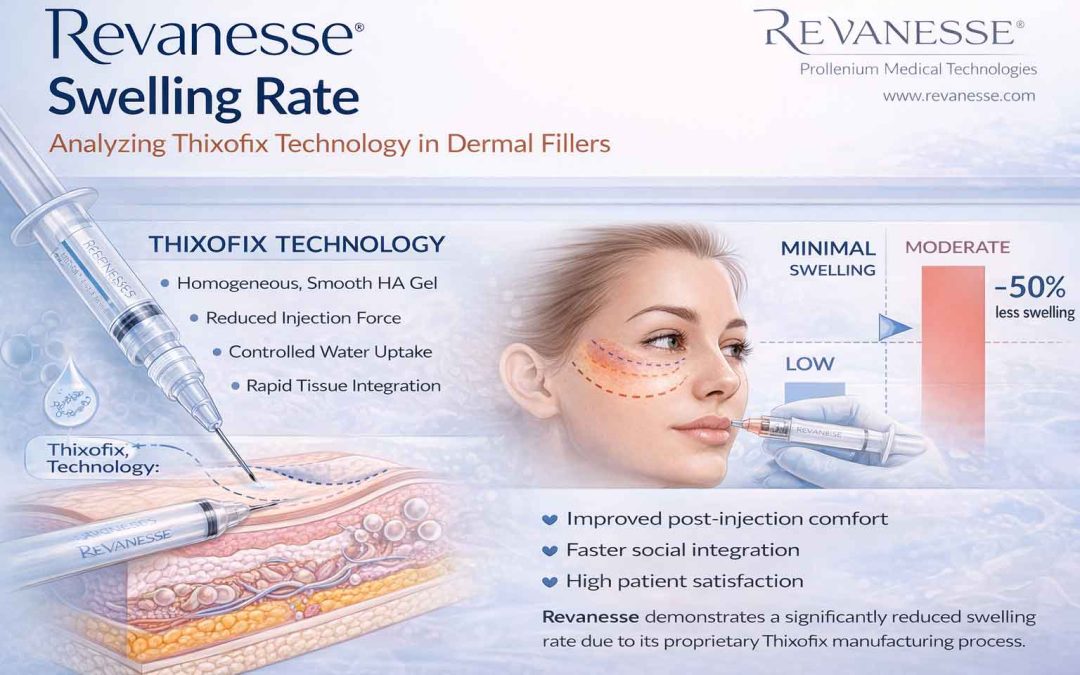
A Clinical Analysis for Precision-Focused Aesthetic Physicians
In aesthetic medicine, post-injection swelling is often underestimated. While it may be acceptable in certain areas or treatments, in others it becomes a limiting factor—both clinically and commercially.
Patients increasingly demand:
- Immediate social reintegration
- Predictable post-treatment appearance
- Minimal downtime
For physicians, swelling directly affects:
- Patient satisfaction
- Follow-up workload
- Perceived treatment quality
This is why the discussion around Revanesse swelling rate has gained relevance. Revanesse, a Canadian hyaluronic acid filler, is frequently promoted as a product with minimal post-injection edema, largely attributed to its proprietary Thixofix technology.
But is this claim clinically justified? And more importantly, does it matter in daily practice?
Why swelling varies between dermal fillers
Post-injection swelling is influenced by multiple variables, but product characteristics play a central role.
Key contributors to swelling
- Hygroscopicity (water-binding capacity)
- Degree of crosslinking
- Particle size and uniformity
- Injection depth and technique
- Tissue integration speed
Fillers with high water attraction tend to expand after injection, increasing tissue pressure and edema. Conversely, fillers designed for controlled expansion and rapid tissue adaptation often show lower swelling profiles.
Introducing Revanesse: the Canadian approach to precision fillers
Revanesse is a hyaluronic acid filler range developed and manufactured in Canada, with a strong emphasis on consistency, purity and predictability.
Manufacturer: Prollenium Medical Technologies
Official source: https://www.prollenium.com
Product site: https://www.revanesse.com
While less aggressively marketed in some regions, Revanesse has built a reputation among injectors who prioritize technical performance over brand hype.
What is Thixofix technology?
Thixofix is Revanesse’s proprietary manufacturing process, designed to create a homogeneous, smooth gel structure with specific rheological behavior.
Thixotropy explained (in clinical terms)
A thixotropic gel:
- Becomes less viscous under shear stress (during injection)
- Recovers its structure once at rest (after placement)
This behavior allows:
- Easier injection with less force
- Reduced tissue trauma
- More controlled product placement
Thixofix technology aims to optimize this behavior while maintaining structural stability.
How Thixofix influences swelling
The link between Revanesse Thixofix technology and swelling lies in several mechanisms:
- Reduced injection pressure
Lower force means less tissue disruption and inflammation. - Uniform particle distribution
Homogeneous gels integrate more smoothly, reducing localized pressure points. - Controlled water uptake
Revanesse fillers are designed to limit post-injection expansion. - Rapid tissue adaptation
Faster integration equals less prolonged edema.
These factors collectively contribute to the low swelling profile reported by many practitioners.
Clinical observation: Revanesse swelling rate in practice
While large-scale head-to-head studies are limited, real-world clinical feedback consistently highlights:
- Minimal immediate swelling
- Faster resolution of post-treatment edema
- Lower incidence of delayed puffiness
This is particularly relevant in areas where swelling is poorly tolerated.
Areas where low swelling matters most
Lips
Even mild edema can distort lip shape and affect patient perception. A lower Revanesse swelling rate allows:
- More predictable immediate results
- Fewer post-treatment complaints
Tear trough
Swelling under the eyes is notoriously difficult to manage. Fillers with low expansion reduce:
- Risk of prolonged edema
- Risk of patient dissatisfaction
Midface and nasolabial folds
Reduced swelling improves:
- Early aesthetic assessment
- Patient confidence in the result
Revanesse vs conventional HA fillers: a clinical comparison
| Parameter | Revanesse | Conventional HA Fillers |
|---|---|---|
| Gel homogeneity | Very high | Variable |
| Injection force | Low | Moderate–high |
| Post-injection swelling | Low | Moderate |
| Tissue integration | Smooth | Variable |
| Immediate predictability | High | Variable |
This comparison explains why Revanesse is often chosen for precision-driven treatments.
Technique still matters: low swelling is not automatic
It is important to emphasize that no filler is immune to poor technique.
Best practices to maintain low swelling:
- Slow injection
- Minimal product per pass
- Correct depth
- Respect for anatomical planes
Revanesse reduces swelling potential—it does not eliminate responsibility.
Patient perception: why low swelling improves satisfaction
From the patient’s perspective:
- Less swelling = less anxiety
- Faster social reintegration
- Higher confidence in the treatment
This directly impacts:
- Reviews and referrals
- Acceptance of repeat treatments
- Overall clinic reputation
Low swelling is not just a clinical advantage—it is a business advantage.
Limitations and realistic expectations
No filler can guarantee:
- Zero swelling
- Identical outcomes in all patients
Factors such as:
- Patient inflammatory response
- Vascularity
- Injection area
will always influence results. Revanesse should be viewed as a risk-reduction tool, not a promise.
Clinical conclusion: is Revanesse the lowest-swelling filler?
Based on:
- Gel homogeneity
- Thixotropic behavior
- Clinical feedback
Revanesse consistently demonstrates a low swelling profile, especially when compared to more hygroscopic or heterogeneous fillers.
For injectors prioritizing:
- Precision
- Immediate predictability
- Minimal downtime
Revanesse represents a strong clinical option.
Revanesse Product Range: Clinical Indications and Swelling Considerations
| Product | HA Concentration | Primary Indication | Key Clinical Characteristics | Relevance to Low-Swelling Strategy |
|---|---|---|---|---|
| Revanesse® Pure | 14 mg/ml | Fine lines, superficial wrinkles | Low viscosity, high homogeneity, excellent tissue integration | Suitable for areas where minimal swelling and subtle correction are required |
| Revanesse® Kiss | 25 mg/ml | Lip augmentation and perioral area | Smooth extrusion, controlled projection, good flexibility | Lower post-injection swelling compared to conventional lip fillers, improving immediate predictability |
| Revanesse® Contour™ | High-density HA | Deep volumization and contouring | High lifting capacity, structural support | Thixofix technology helps limit swelling despite higher volumizing capacity |
| Revanesse® Shape+™ | High-density HA | Facial contouring, chin, jawline | Strong projection with controlled spread | Reduced edema allows better early assessment of contour results |
| Revanesse® Ultra™ | High-density HA | Deep folds, midface volume | Balanced elasticity and cohesivity | Lower swelling profile improves patient comfort and faster social reintegration |
Official sources and manufacturer information
- Revanesse – Prollenium Medical Technologies
https://www.prollenium.com
https://www.revanesse.com
All clinical decisions should be based on individual patient assessment, injector experience and current regulatory guidelines.