
Introduction: in tear trough treatments, edema is the real complicationIf you regularly treat the tear trough, you already know that this area follows different rules from the rest of the face.
Volume correction is rarely the real challenge. The true difficulty lies in achieving a stable result over time without chronic swelling.
For experienced injectors, the number one concern is not Tyndall effect or overcorrection. It is persistent malar edema—a complication that can appear weeks or months after treatment and is notoriously difficult to resolve.
This is precisely why the comparison Redensity 2 vs Belotero Balance tear trough generates so much interest among aesthetic physicians. Both products are widely used, both are considered “safe” when injected correctly, and both can deliver excellent aesthetic results. Yet, their behavior in edema-prone patients is not the same.
Understanding why requires moving beyond brand reputation and focusing on hygroscopicity, tissue interaction, and lymphatic dynamics—factors that directly influence long-term outcomes in the infraorbital region.
Why the tear trough is uniquely prone to edema
The tear trough is anatomically predisposed to fluid retention for several reasons:
- Extremely thin skin
- Minimal subcutaneous fat
- Dense ligamentous structures
- A superficial lymphatic network
- Continuous gravitational and muscular forces
Any filler placed in this area interacts not only with skin and bone, but also with lymphatic drainage pathways. Even minimal changes in tissue pressure or water attraction can result in visible swelling.
This means that in the tear trough, filler selection is a safety decision, not merely an aesthetic one.
Malar edema: a complication that is often underestimated
Malar edema is frequently misunderstood as simple post-procedural swelling. In reality, chronic malar edema is a pathophysiological process, not a transient inflammatory response.
Common contributing factors include:
- Excessive water-binding by the filler
- Superficial placement
- Compression of lymphatic vessels
- Pre-existing malar bags or festoons
- Patient-related fluid retention tendencies
Once established, malar edema may persist despite:
- Massage
- Corticosteroids
- Hyaluronidase (with variable success)
This is why prevention is far more important than treatment.
Hygroscopicity: the most critical variable in tear trough fillers
Hygroscopicity refers to a filler’s capacity to attract and retain water from surrounding tissues.
In many facial areas, this property is beneficial:
- It improves hydration
- Enhances skin quality
- Contributes to a “fresh” appearance
In the tear trough, however, hygroscopicity becomes a liability.
Why water attraction matters under the eye
Even a small amount of water retention can:
- Increase tissue pressure
- Compromise lymphatic drainage
- Create visible puffiness
- Convert a good result into a long-term complication
For this reason, low-hygroscopic fillers are generally safer in edema-prone patients, regardless of how natural the initial result may look.
Teosyal Redensity 2: engineered to minimize water attraction
Product background
Teosyal Redensity 2 was specifically developed for the tear trough region. Unlike multi-purpose fillers adapted for under-eye use, its formulation reflects a risk-reduction philosophy.
Manufacturer: Teoxane Laboratories
Official source: https://www.teoxane.com
Key formulation characteristics
- Low crosslinking density
- Low hygroscopicity
- Soft, cohesive gel
- Excellent tissue integration
- Redensification complex (amino acids, antioxidants, minerals)
From a clinical standpoint, the most important feature is its controlled interaction with water.
Clinical behavior of Redensity 2 in the tear trough
In daily practice, Redensity 2 tends to:
- Produce minimal immediate swelling
- Remain stable over time
- Show a low incidence of delayed edema
- Integrate smoothly without excessive expansion
For this reason, many experienced injectors consider Redensity 2 a first-choice filler in high-risk patients, including those with:
- Morning periorbital swelling
- Malar bags
- Previous filler-related edema
- Lymphatic congestion
Belotero Balance: excellent integration with moderate hygroscopicity
Product background
Belotero Balance is part of the Belotero range by Merz Aesthetics and uses CPM (Cohesive Polydensified Matrix) technology, which allows very homogeneous tissue integration.
Manufacturer: Merz Aesthetics
Official sources:
https://belotero.com
https://merzaesthetics.com
Key formulation characteristics
- CPM technology
- High cohesivity
- Very smooth tissue integration
- Moderate hygroscopicity
- Suitable for superficial placement
Belotero Balance is often praised for how “invisible” it looks after injection, particularly in superficial areas.
Clinical behavior of Belotero Balance in the tear trough
In well-selected patients, Belotero Balance can:
- Deliver extremely natural results
- Blend seamlessly with surrounding tissue
- Allow superficial correction without Tyndall effect
However, its moderate water attraction means that:
- Edema risk increases in fluid-retaining patients
- Results may change over time
- Swelling can appear weeks after treatment
This does not make Belotero Balance unsafe—but it does make patient selection absolutely critical.
Redensity 2 vs Belotero Balance tear trough: direct clinical comparison
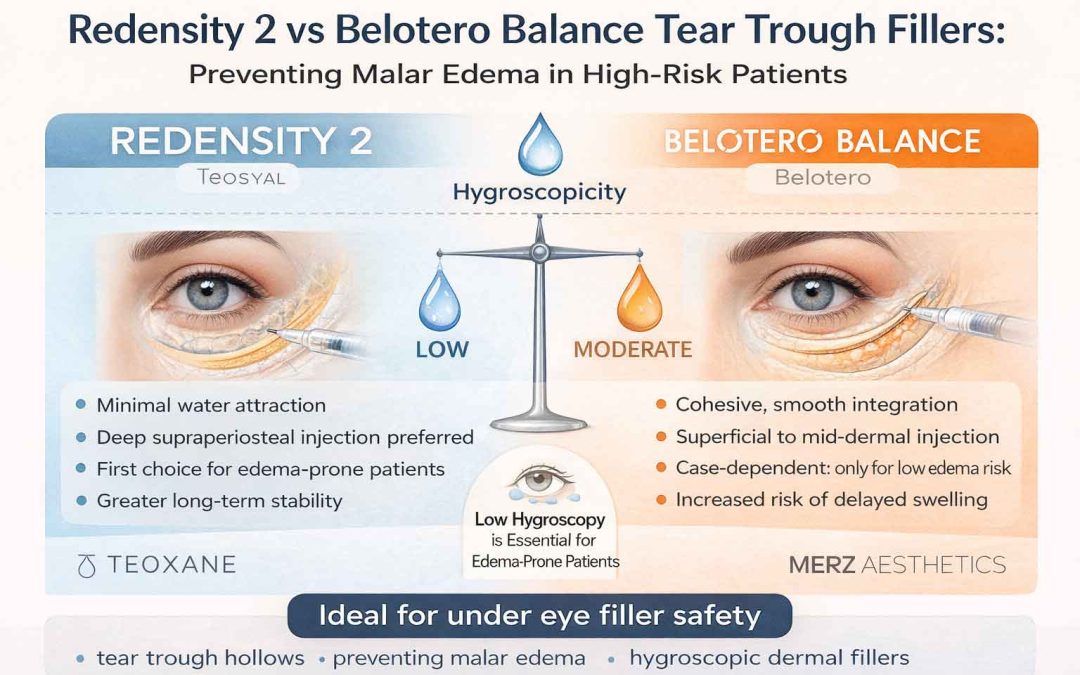
| Parameter | Redensity 2 | Belotero Balance |
|---|---|---|
| Hygroscopicity | Low | Moderate |
| Risk of malar edema | Low | Moderate |
| Tissue integration | Very good | Excellent |
| Ideal patient profile | Edema-prone | Low edema risk |
| Injection depth | Deep supraperiosteal / submuscular | Superficial to mid-dermal |
| Long-term stability | High | Variable |
| Safety margin | Higher | Technique-dependent |
This comparison explains why the keyword “Redensity 2 vs Belotero Balance tear trough” reflects a real clinical dilemma rather than a marketing debate.
Identifying patients at high risk of malar edema
Certain patient profiles should immediately raise caution:
- History of under-eye swelling on waking
- Visible malar bags or festoons
- Thin, lax infraorbital skin
- Poor midface support
- Previous complications with tear trough fillers
- Systemic fluid retention tendencies
In these patients, choosing a low-hygroscopic filler is a preventive strategy, not an aesthetic preference.
Injection technique: product choice is not enough
Even the safest filler can cause edema if injected incorrectly.
Best practices include:
- Minimal volumes
- Deep placement when indicated
- Avoidance of superficial boluses
- Conservative correction with reassessment
- Respect for infraorbital anatomy
That said, product properties define the ceiling of safety, while technique determines whether you reach it.
Why this topic attracts high-quality search traffic
From an SEO perspective, this topic performs well because it addresses:
- A real clinical fear
- A common but under-discussed complication
- A high-risk aesthetic indication
- A product comparison with safety implications
Professionals searching for preventing malar edema fillers are not beginners. They are injectors looking to reduce complications, not increase volume.
This is exactly the type of audience that:
- Reads long-form content
- Values scientific reasoning
- Converts into high-quality leads
Clinical decision-making: how experienced injectors choose
In practice:
- Redensity 2 is often chosen for safety-first protocols
- Belotero Balance is selected for low-risk patients with excellent tissue quality
The key difference is not immediate aesthetic outcome, but how the result behaves months later.
Managing patient expectations
Clear communication is essential:
- Explain that under-eye fillers are not about volume
- Discuss edema risk openly
- Emphasize stability over immediacy
Patients who understand the risks are far more satisfied with conservative, stable results.
Conclusion: hygroscopicity defines safety in tear trough treatments
When treating difficult tear troughs, the debate Redensity 2 vs Belotero Balance tear trough should be guided by risk assessment, not brand preference.
- Redensity 2 offers greater safety in edema-prone patients due to low hygroscopicity
- Belotero Balance delivers excellent results in carefully selected, low-risk cases
In the infraorbital region, the best outcome is not the most visible correction—but the one that remains stable, discreet, and edema-free over time.
Official sources and references
- Teoxane Laboratories – Teosyal Redensity 2
https://www.teoxane.com - Merz Aesthetics – Belotero Balance
https://belotero.com
https://merzaesthetics.com
These official sources provide validated information regarding product composition, rheology and clinical indications. Final treatment decisions should always be based on individual patient assessment and clinical experience.