
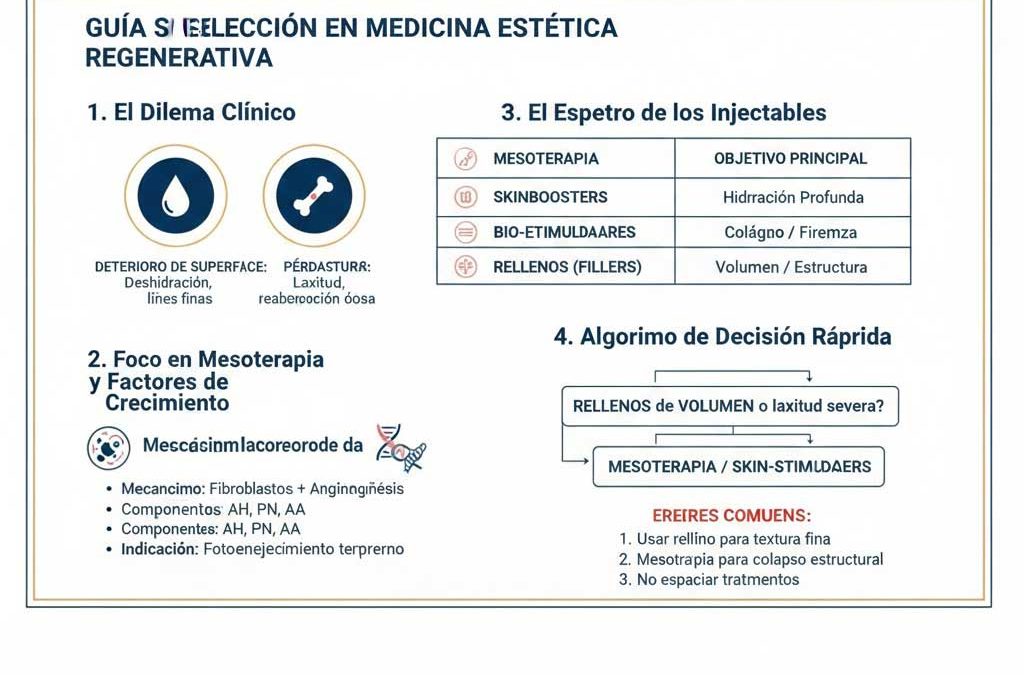
Medical mesotherapy has evolved significantly over the past decade. What was once considered a superficial hydration technique is now a structured therapeutic approach that includes growth factors, polynucleotides, skinboosters, and regenerative injectables.
However, confusion remains in daily practice:
When should a clinician choose mesotherapy instead of dermal fillers?
When are bio-stimulators more appropriate?
Is there real scientific evidence supporting growth factor–based protocols?
This article provides an evidence-based framework to clarify indications and optimize treatment selection.
Understanding the Biological Targets
Before choosing a product or technique, the clinician must identify the primary biological deficit:
- Volume loss (fat or bone resorption)
- Dermal thinning
- Reduced collagen production
- Dehydration
- Skin laxity
- Textural irregularities
Each injectable category addresses a different biological level.
What Is Medical Mesotherapy?
Medical mesotherapy refers to multiple microinjections into the superficial dermis or upper subcutaneous layer, delivering active substances designed to stimulate regeneration rather than create volume.
Depending on formulation, mesotherapy may include:
- Non-crosslinked hyaluronic acid
- Growth factors
- Polynucleotides
- Amino acids and antioxidants
- Vitamin complexes
Its objective is to improve:
- Skin quality
- Hydration
- Elasticity
- Fine lines
- Overall dermal vitality
It does not aim to restore structural volume.
Growth Factors in Mesotherapy: Mechanism and Evidence
Growth factors are signaling proteins involved in cellular repair and regeneration. In aesthetic medicine, they are used to stimulate fibroblast activity and enhance collagen synthesis.
Mechanism of action:
- Activation of fibroblast proliferation
- Stimulation of collagen I and III production
- Promotion of angiogenesis
- Enhancement of extracellular matrix remodeling
Clinical literature suggests that growth factor–based treatments may improve:
- Dermal thickness
- Skin elasticity
- Fine wrinkling
- Post-inflammatory healing
However, results depend heavily on product formulation, injection depth, and treatment intervals.
Evidence supports their use primarily for:
- Early to moderate photoaging
- Post-procedure recovery
- Adjunctive therapy with lasers or microneedling
They are not substitutes for structural correction in advanced aging.
Skinboosters: Hydration with Structural Support
Skinboosters typically contain stabilized, lightly crosslinked hyaluronic acid designed for intradermal placement.
Unlike fillers, their purpose is not projection but long-term dermal hydration and improvement of skin texture.
Clinical benefits include:
- Improved skin smoothness
- Increased dermal hydration
- Reduction of superficial lines
- Enhanced luminosity
Histological studies have demonstrated increased collagen expression following repeated skinbooster treatments.
Skinboosters are particularly effective in:
- Perioral region
- Neck
- Décolletage
- Thin, photodamaged skin
Dermal Fillers: Structural Volume Replacement
Fillers are indicated when the primary issue is:
- Deep volume loss
- Fat compartment deflation
- Bone resorption
- Structural collapse
They restore projection and facial architecture.
Fillers should not be used to treat:
- Fine creping
- Diffuse skin thinning
- Dehydration
Using structural fillers to compensate for poor skin quality often results in overcorrection.
Bio-stimulators: Inducing Collagen Production
They are indicated when:
- Laxity is present
- Dermal thinning is moderate to advanced
- Structural support is required with gradual improvement
They are not immediate volumizers but induce progressive improvement over months.
Clinical Decision-Making Framework
| Primary Concern | Recommended Approach | Rationale |
|---|---|---|
| Dehydrated skin | Skinboosters | Dermal hydration |
| Fine superficial lines | Mesotherapy | Cellular stimulation |
| Early dermal thinning | Growth factors | Fibroblast activation |
| Deep volume loss | Fillers | Structural support |
| Laxity with collagen decline | Bio-stimulators | Neocollagenesis |
| Combination aging | Layered protocol | Multilevel correction |
When to Combine Treatments
Modern aesthetic protocols increasingly rely on layered approaches.
Example combination:
- Structural filler for projection
- Skinbooster for dermal hydration
- Growth factor mesotherapy for regeneration
Spacing treatments appropriately is critical to avoid inflammation overload.
Evidence-Based Considerations
Scientific evidence varies by product category.
- Hyaluronic acid fillers: extensive clinical data
- Bio-stimulators: moderate to strong evidence
- Skinboosters: growing body of histological and clinical data
- Growth factor mesotherapy: promising but more heterogeneous evidence
Clinicians must differentiate between marketing claims and peer-reviewed data.
Special Considerations in Mature Patients
In patients over 55, combining modalities often yields superior results:
- Fillers alone do not improve dermal thinning
- Mesotherapy alone does not correct structural collapse
- Bio-stimulation may require multiple sessions
Treatment sequencing becomes essential.
Common Clinical Mistakes
- Using fillers to treat skin texture
- Performing mesotherapy in patients who need structural correction
- Overlapping multiple regenerative treatments without spacing
- Ignoring patient-specific inflammatory response
Conclusion
Medical mesotherapy with growth factors and skinboosters plays a valuable role in aesthetic medicine when correctly indicated. The key distinction lies in identifying whether the patient requires:
- Hydration
- Regeneration
- Structural volume
- Collagen induction
Each injectable category targets a different biological layer. Mastery in aesthetic medicine is not about product preference, but about precise biological indication.
Official Sources and Scientific References
The clinical concepts discussed in this article are aligned with published scientific literature and official manufacturer documentation related to hyaluronic acid fillers, skinboosters, bio-stimulators, and regenerative injectables. For further evidence-based information, clinicians may consult:
- International Society of Aesthetic Plastic Surgery (ISAPS):
https://www.isaps.org - PubMed – National Library of Medicine (peer-reviewed medical literature):
https://pubmed.ncbi.nlm.nih.gov - European Medicines Agency (EMA) – Regulatory information on medical products:
https://www.ema.europa.eu - American Society for Dermatologic Surgery (ASDS) – Clinical guidelines and resources:
https://www.asds.net
Clinicians are encouraged to review up-to-date peer-reviewed studies and official regulatory documentation when selecting treatment protocols involving mesotherapy, skinboosters, fillers, or bio-stimulators.