
Clinical analysis of Vycross® (Juvéderm) vs. Tri-Hyal® (Fillmed Art Filler) technology. We compare rheology, integration, and results. The definitive guide for aesthetic medical professionals on which HA filler to choose.
The Professional’s Challenge: Not All Hyaluronic Acids Are Created Equal
In modern aesthetic medicine, assuming all hyaluronic acid (HA) fillers are interchangeable is a clinical mistake. The performance, longevity, integration, and final result of a treatment depend not just on the HA concentration, but on the science behind its cross-linking.
This leads to one of the most common comparisons in clinical practice: Juvéderm vs Fillmed. At the heart of this debate are their two signature technologies: Vycross® from Allergan (Juvéderm) and Tri-Hyal® from Laboratoires Fillmed (Art Filler).
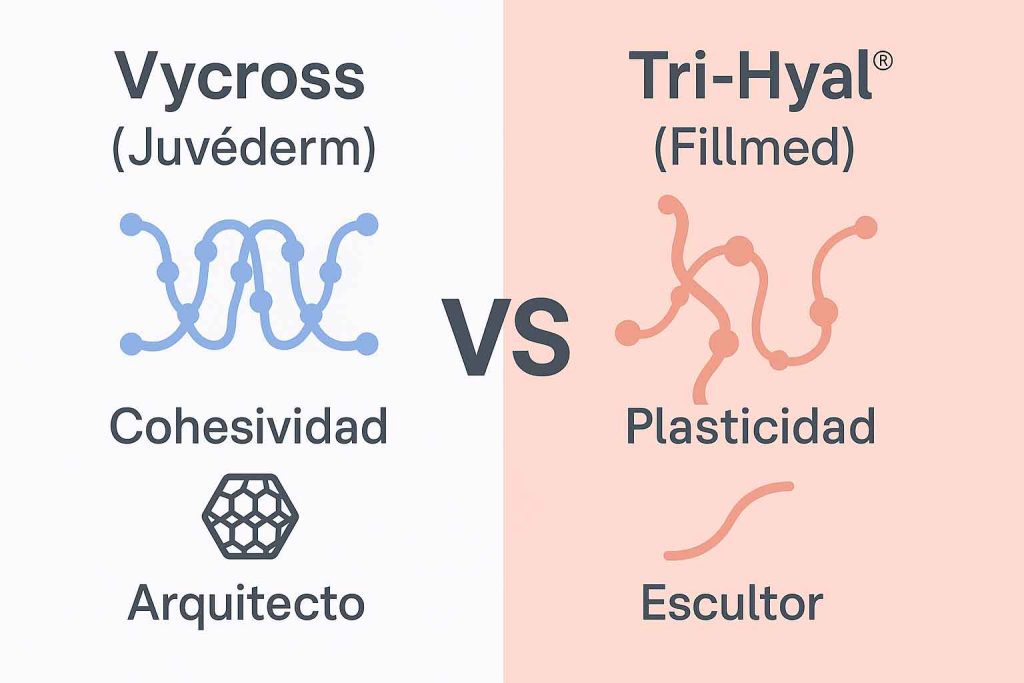
Both deliver excellent results, but they are designed with fundamentally different tissue-engineering philosophies. As a professional, when should you choose the cohesivity of Vycross, and when the plasticity of Tri-Hyal?
This article is a technical, comparative analysis to help you make the right decision for each patient.
The Key to Everything: A Quick Reminder on Rheology
Before we compare, we must speak the same language. Rheology is the study of how materials flow and deform. In a filler, we primarily look at:
- G’ (Elastic Modulus): The “firmness” or ability of the gel to resist deformation. A high G’ is ideal for projection and lifting (e.g., cheekbones, chin).
- Cohesivity: The gel’s ability to “stick together” (not migrate). This is crucial for a defined and natural result.
- Plasticity/Moldability: The ease with which the gel can be shaped by the injector (and how it adapts to movement).
(For a deeper analysis, we recommend reading our guide: A Professional’s Guide to Rheology: How to Select the Ideal Dermal Filler for Every Indication).
Technology Analysis: Vycross® by Juvéderm (The Architect)
Allergan’s Vycross® technology (found in the Voluma, Volift, Volbella, Volux range) was revolutionary. Instead of using only high-molecular-weight HA chains, Vycross combines 90% low-molecular-weight with 10% high-molecular-weight HA.
How does it work?
This combination allows for a much more efficient cross-linking process. Less cross-linker (BDDE) is needed to achieve a robust, long-lasting gel.
Rheological Profile and Clinical Advantages
- High Cohesivity: This is the primary advantage of Vycross. The gel integrates exceptionally well with tissue, feels natural to the touch, and is highly resistant to migration.
- Less Edema: By being a more efficient network, it attracts less water (it is less hydrophilic) immediately post-injection. This translates to less swelling for the patient and a more predictable result (what you see is what you get).
- Durability: The efficient cross-linking offers one of the longest durations on the market, especially in high G’ products like
Juvéderm VolumaandVolux.
The Ideal Injector for Vycross:
The professional seeking projection, structure, and contour with exceptional durability. It is the “architect’s” tool for building cheekbones, defining jawlines, and providing structural support.
(Discover more about Juvéderm’s hydration innovation in our article: JUVÉDERM® SKINVIVE™ for Skin Quality: Microdroplet Technique, Patient Selection, Dosing, and Safety (A Professional Guide)).
Technology Analysis: Tri-Hyal® by Fillmed (The Sculptor)
Fillmed’s Tri-Hyal® technology (found in the Art Filler range) takes a different approach. As its name suggests, it is based on a balance of three different types of HA chains: long, very long, and free (non-cross-linked) HA.
How does it work?
This tri-hybrid combination is designed to optimize the product’s moldability. It doesn’t just focus on firmness (G’), but on the ease with which the gel can be sculpted and adapt to dynamic areas.
Rheological Profile and Clinical Advantages
- Superior Plasticity: This is Fillmed’s crown jewel. The Art Filler gels are incredibly easy to mold and inject. They adapt perfectly to high-movement areas (like the lips) without creating lumps.
- “Dynamic” Results: The gel is designed to move with the patient’s expressions, yielding an ultra-natural result.
- Free HA (Hydration): The inclusion of free HA provides a biorevitalization benefit and immediate hydration, improving the quality of the surrounding skin (a “glow effect”).
The Ideal Injector for Tri-Hal:
The professional seeking naturalness, integration in mobile zones, and ease of sculpting. It is the “artist’s” tool for creating perfect lips, filling perioral lines, and treating areas where a gel that is too “firm” would look artificial.
Clinical Verdict: Vycross vs. Tri-Hyal Comparative Table
| Feature | Vycross® (Juvéderm) | Tri-Hyal® (Fillmed) |
| Base Technology | 90% Low-MW + 10% High-MW HA | Balance of 3 Chains (Long, Very Long, Free) |
| Key Strength | High Cohesivity & Durability | High Plasticity & Moldability |
| G’ (Projection) | Very High (e.g., Volux, Voluma) | High (e.g., Volume) |
| Dynamic Adaptation | Good | Excellent |
| Free HA (Hydration) | No (except Skinvive) | Yes, in the entire range |
| Post-Injection Edema | Very Low | Low (can be slightly higher due to free HA) |
| Ideal For… | Projection, structure, contour | Mobile zones (lips), naturalness, sculpting |
Conclusion: Architect or Sculptor? You Need Both.
As a professional, the question isn’t “Which is better?” but “What does my patient need?”
You should choose Vycross® (Juvéderm) when…
- …the primary goal is projection, lift, and structural support (cheekbones, chin, jawline angle).
- …the patient is prone to swelling and desires a recovery with minimal edema.
- …longevity is the deciding factor.
You should choose Tri-Hyal® (Fillmed) when…
- …the primary goal is treating dynamic areas (lips, perioral) with a natural result in motion.
- …the patient has thin skin and would benefit from a very moldable and easy-to-integrate gel.
- …you are looking for a “two-in-one”: filling and a skin quality improvement thanks to the free HA.
Both technologies represent the pinnacle of HA engineering. Stocking both in your clinic elevates you from a simple injector to a true expert in facial rejuvenation, capable of selecting the precise tool for every job.
Here is a list of authoritative URLs you can use as sources or for a “Further Reading” section in your article.
Adding these links can help boost your article’s E-E-A-T (Expertise, Authoritativeness, Trustworthiness) by showing that your information is based on scientific literature and primary manufacturer data.
Sources and Further Reading
https://pmc.ncbi.nlm.nih.gov/articles/PMC9188840/
Allergan Aesthetics (Juvéderm Manufacturer): This is the official professional-facing site from Allergan, detailing the Juvéderm product portfolio, including those using Vycross technology.
https://www.allerganaesthetics.es/sobre/productos
Fillmed Laboratoires (Art Filler Manufacturer): This is the official professional-facing site from Fillmed, detailing the Art Filler range which utilizes the Tri-Hyal technology.
https://es.fillmed.com/correccion-artfiller/
PubMed (NIH): The Rheology of HA Fillers (Clinical Review): A detailed review article from the National Institutes of Health database, explaining the importance of rheological properties (like G’ and cohesivity) and their clinical implications.
https://pubmed.ncbi.nlm.nih.gov/36142430/
PMC (NIH): Overview of Rheologic Characteristics (Clinical Review): Another full-text scientific article from the National Institutes of Health that provides an overview of rheologic properties and their relationship to product performance.