
Introduction: body treatments are no longer secondary in aesthetic practice
If you work in aesthetic medicine, you already know this: Hyacorp vs Sculptra buttocks is a comparison that has become increasingly relevant as non-surgical gluteal augmentation is no longer an “extra” treatment. It has evolved into one of the highest-demand and highest-margin procedures in many clinics.
The challenge is not patient interest, but clinical decision-making. Not every patient wants the same outcome, and not every injectable behaves the same way in every body type. Choosing between Hyacorp MLF2 and Sculptra should not be a matter of personal preference or inventory availability, but of proper indication.
One of the most reliable and practical criteria in daily practice is the patient’s BMI.
Two completely different approaches to gluteal enhancement
Although they are often discussed together, Hyacorp and Sculptra serve very different purposes in gluteal treatments.
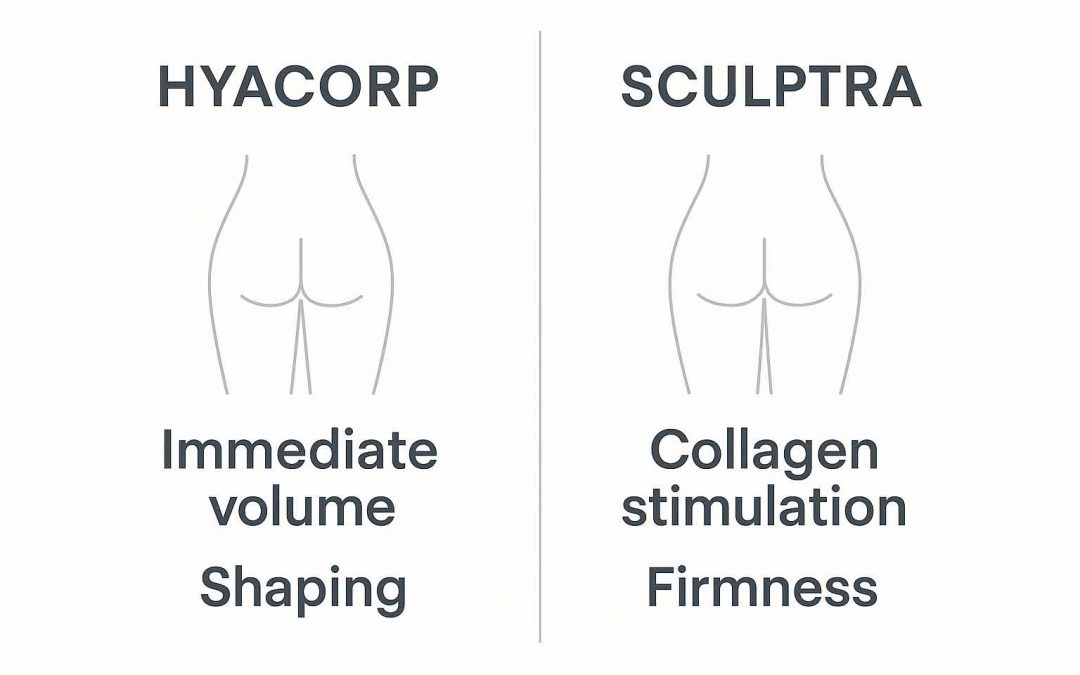
Hyacorp MLF2: immediate volume and contour control
Hyacorp MLF2 is a highly cross-linked, large-particle hyaluronic acid specifically designed for high-volume body contouring.
In clinical terms, Hyacorp functions as a true volumizing filler:
- Immediate and predictable volume
- High cohesivity and projection capacity
- Allows shaping and contour definition
- Reversible with hyaluronidase
It is particularly suitable when the patient expects a visible and immediate change after a single session.
Sculptra: progressive biostimulation, not “filling”
Sculptra, based on poly-L-lactic acid (PLLA), should not be approached as a volumizer. Its primary role is collagen stimulation.
In the buttocks, Sculptra:
- Does not provide immediate volume
- Gradually increases dermal thickness
- Improves firmness and tissue quality
- Produces subtle, progressive enhancement
It is best understood as a tissue-building treatment, not a shaping filler.
Why BMI is a key variable in gluteal injectable treatments
One of the most common clinical errors in gluteal augmentation is selecting the product without considering body composition.
BMI directly influences:
- How volume is perceived
- How injectables integrate into tissue
- The risk of unnatural contours
- Overall patient satisfaction
Using a BMI-based decision framework simplifies indication and reduces complications.
Hyacorp vs Sculptra buttocks: clinical comparison
| Parameter | Hyacorp MLF2 | Sculptra |
|---|---|---|
| Primary action | Volume replacement | Collagen stimulation |
| Immediate result | Yes | No |
| Result evolution | Stable volume | Progressive improvement |
| Ideal BMI range | Normal to high | Low to normal |
| Injection volume | High | Moderate |
| Reversibility | Yes | No |
| Main indication | Projection and shape | Tissue quality and firmness |
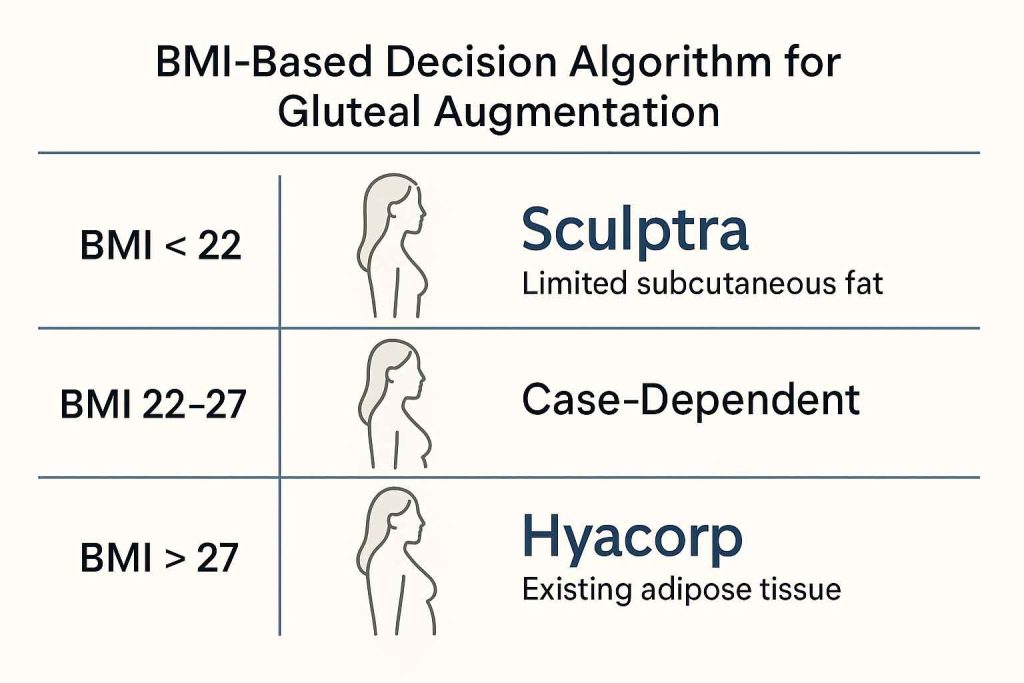
Practical decision algorithm based on BMI
BMI < 22 – Lean patients
This group typically includes slim or athletic patients with:
- Limited subcutaneous fat
- Thin skin
- Higher risk of visible irregularities
Preferred option: Sculptra
In these patients, large volumes of hyaluronic acid may appear artificial or palpable. Sculptra allows you to:
- Thicken tissue progressively
- Improve firmness
- Maintain a natural appearance
For lean patients, volume should be built biologically, not injected mechanically.
BMI 22–27 – Average body composition
This is the most flexible group.
Possible approaches:
- Hyacorp for patients seeking immediate volume
- Sculptra for progressive improvement
- Combination protocols for experienced injectors
Decision-making should be guided by:
- Patient expectations
- Timeframe for results
- Desired degree of projection
Personalization is essential here.
BMI > 27 – Higher body mass
Patients with higher BMI usually present:
- Adequate adipose support
- Better tolerance of volume
- Clear demand for projection and contour
Preferred option: Hyacorp MLF2
In this group, hyaluronic acid integrates well and provides:
- Immediate visible results
- Improved gluteal contour
- High patient satisfaction after one session
Reversibility remains an important safety advantage in high-volume treatments.
Safety considerations: non-negotiable in gluteal injectables
Gluteal augmentation requires advanced anatomical knowledge and technique.
Key principles include:
- Deep subcutaneous plane only
- Use of appropriate cannulas
- Slow, controlled injection
- Strict avoidance of intramuscular placement
Both products demand experience, but hyaluronic acid offers an additional safety margin due to reversibility.
Business perspective: choosing the right treatment to offer
From a practice management standpoint:
- Hyacorp generates high single-session revenue
- Sculptra encourages repeat visits and long-term patient retention
Clinics that offer both options can:
- Adapt to different patient profiles
- Avoid inappropriate indications
- Maximize treatment acceptance and profitability
Patient communication: setting expectations correctly
Clear explanation is essential:
- Hyacorp = immediate volume and shape
- Sculptra = gradual improvement in firmness and tissue quality
When patients understand what will happen and when, satisfaction increases significantly.
Clinical conclusion
The discussion around Hyacorp vs Sculptra buttocks is not about which product is superior, but about appropriate patient selection.
- Hyacorp excels in immediate, high-volume gluteal augmentation
- Sculptra excels in biostimulation and tissue quality improvement
Using BMI as a clinical decision tool leads to safer treatments, more predictable results, and better long-term outcomes.
In body aesthetics, correct indication is not only good medicine—it protects your practice.
Official Sources and References
The clinical information and product characteristics discussed in this article are based on official manufacturer data, scientific documentation and publicly available professional resources from the respective laboratories:
- Hyacorp® (BioScience GmbH)
Official product information and scientific background on Hyacorp MLF2 for body contouring and gluteal augmentation.
https://hyacorp.com - Sculptra® (Galderma)
Official product documentation, indications and scientific data regarding poly-L-lactic acid (PLLA) biostimulation for facial and body applications.
https://www.sculptraaesthetic.com
https://www.galderma.com