
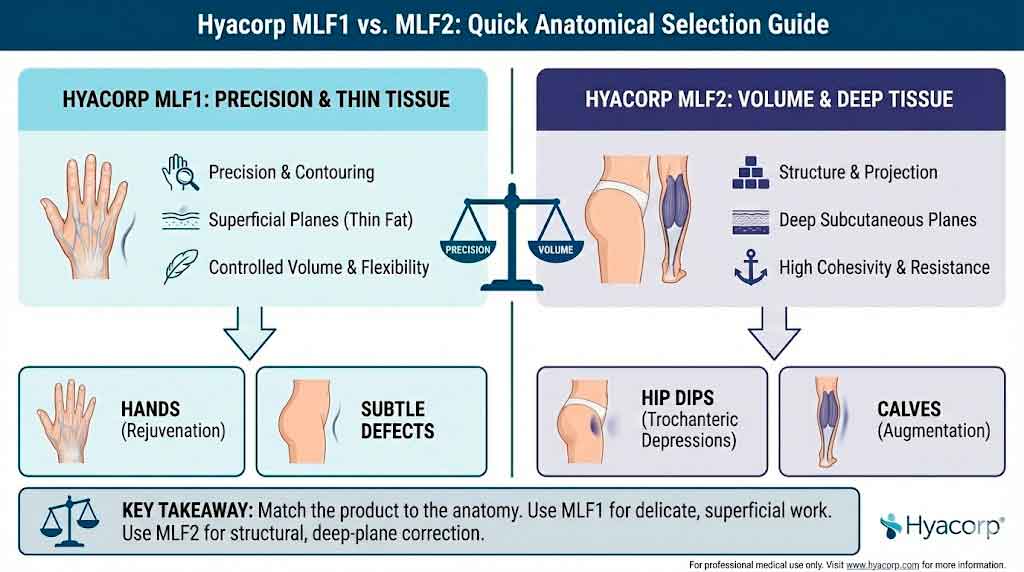
Clinical context: why product selection matters in non-standard body contouring
Body contouring with hyaluronic acid has evolved well beyond gluteal augmentation. In current aesthetic practice, physicians are increasingly asked to address less common but anatomically demanding areas such as calves, hands, and trochanteric depressions (hip dips). This clinical shift has increased interest in comparative decision-making, particularly when evaluating Hyacorp MLF1 vs MLF2 for specific body contouring indications.
These indications require a high level of anatomical precision. Unlike gluteal treatments, where large volumes and deep fat compartments dominate decision-making, these areas differ significantly in:
– Thickness of subcutaneous tissue
– Vascular and functional anatomy
– Mechanical stress and mobility
For this reason, product selection—not just injection technique—is critical.
Within the body filler category, Hyacorp MLF1 and MLF2, developed by Hyacorp, are frequently discussed together but often misunderstood. Although part of the same product family, they are not interchangeable and serve distinct anatomical purposes.
Understanding the Hyacorp MLF range
Hyacorp MLF fillers are monophasic, highly cross-linked hyaluronic acid gels specifically designed for body indications, offering long-lasting volume and high cohesivity.
The key difference between MLF1 and MLF2 lies in their rheological behavior, which directly determines their suitability for different anatomical regions.
Core formulation differences
| Parameter | Hyacorp MLF1 | Hyacorp MLF2 |
|---|---|---|
| Gel density | Moderate | High |
| Elasticity (G’) | Lower | Higher |
| Cohesivity | High | Very high |
| Volume capacity | Controlled | Large-volume |
| Target tissue depth | Superficial / limited SC fat | Deep subcutaneous |
Hyacorp MLF2: large-volume correction in well-defined subcutaneous planes
Hyacorp MLF2 is formulated for areas requiring significant volume replacement and structural projection, where sufficient subcutaneous tissue is present to safely accommodate a dense filler.
Primary indications
- Trochanteric depressions (hip dips)
- Calf augmentation
- Selected body asymmetries requiring projection
Trochanteric depressions (Hip Dips)
Hip dips are not a defect but an anatomical feature related to pelvic bone structure and fat distribution. However, many patients seek correction to improve lateral hip continuity.
In this indication:
- Large volumes are often required
- Injection is performed in deep subcutaneous planes
- Product migration must be avoided
MLF2 provides the necessary projection and stability, allowing gradual contour restoration without surface irregularities when placed correctly.
Calf contouring
Calf augmentation demands:
- High mechanical resistance
- Long-term shape retention
- Minimal deformation during muscle contraction
MLF2’s rheology makes it suitable for deep subcutaneous calf augmentation, provided anatomical landmarks and neurovascular structures are strictly respected.
Hyacorp MLF1: precision filler for areas with limited subcutaneous tissue
In contrast, Hyacorp MLF1 is designed for areas where volume must be added cautiously, and where overcorrection or excessive stiffness would lead to functional or aesthetic complications.
Primary indications
- Hand rejuvenation
- Subtle contour defects
- Areas with thin subcutaneous fat layers
Hand rejuvenation
The dorsum of the hand contains:
- Superficial veins and tendons
- Minimal fat coverage
- High functional mobility
In this context, MLF2 would be excessively dense. MLF1 offers better adaptability, allowing:
- Natural dorsal hand contour restoration
- Reduced risk of palpability
- Smoother integration over extensor tendons
Why MLF1 and MLF2 are not interchangeable
A common clinical error is assuming that MLF2 can be “downscaled” for all body indications. In reality, overly dense fillers in low-fat areas increase the risk of irregularities, stiffness, and unnatural contours.
Selection summary by anatomical indication
| Area | Recommended product | Rationale |
|---|---|---|
| Trochanteric depressions | Hyacorp MLF2 | Large volume, deep planes |
| Calves | Hyacorp MLF2 | Structural projection, resistance |
| Hands | Hyacorp MLF1 | Thin tissue, precision required |
| Areas with low SC fat | Hyacorp MLF1 | Controlled volume, flexibility |
Safety considerations and clinical planning
Both Hyacorp MLF1 and MLF2 are medical devices intended exclusively for trained professionals. Safe outcomes depend on:
- Detailed anatomical knowledge
- Correct plane selection
- Conservative volume planning
- Progressive correction protocols
Particularly in hip dips and calves, staged treatments are recommended to optimize contour and minimize complication risk.
SEO-focused clinical differentiation
Unlike generic content focused on gluteal augmentation, this comparison addresses specific, high-intent professional searches, such as:
- Hyacorp MLF1 vs MLF2
- Trochanteric depression filler
- Calf filler hyaluronic acid
- Hand filler body HA
These indications reflect real clinical demand and are rarely covered in depth, offering strong differentiation and positioning as an expert resource.
Conclusion
Hyacorp MLF1 and MLF2 are complementary—not competing—body fillers.
Their correct use depends on anatomical precision, not volume preference.
- MLF2 is the product of choice for large-volume body contouring in areas with adequate subcutaneous tissue, such as trochanteric depressions and calves.
- MLF1 is better suited for precision work in areas with limited tissue coverage, such as hand rejuvenation.
For physicians treating advanced body contouring indications beyond gluteal augmentation, understanding this distinction is essential for achieving predictable, natural, and safe outcomes.
Official sources and technical references
The clinical and technical information presented in this article is based on data provided by the manufacturer, together with regulatory documentation and peer-reviewed scientific literature relevant to the use of hyaluronic acid for body contouring indications.
Manufacturer and official documentation
- Hyacorp – Official website
https://www.hya-corp.com - Hyacorp MLF product range – body contouring applications
https://www.hya-corp.com/products
Medical device regulation and safety
- European Commission – Medical Device Regulation (MDR)
https://health.ec.europa.eu/medical-devices-sector/overview-medical-devices_en - European Medicines Agency (EMA) – Regulatory framework
https://www.ema.europa.eu
Anatomy, technique, and scientific literature
Journal of Cosmetic Dermatology
https://onlinelibrary.wiley.com/journal/14732165
National Center for Biotechnology Information (NCBI / PubMed)
https://pubmed.ncbi.nlm.nih.gov
Aesthetic Plastic Surgery (Springer Journal)
https://link.springer.com/journal/266