
A Technical Analysis of Crosslinking, Cohesivity and G′ in High-Load Facial Areas
Introduction: deep malar support is about resistance, not volume
When treating the deep malar region, volume alone is not the goal. What experienced injectors truly seek is resistance to deformation When treating the deep malar region, volume alone is not the goal. What experienced injectors truly seek is resistance to deformation under dynamic load, a concept directly linked to E-BRID crosslinking technology. The malar area is exposed to constant mechanical stress from facial expression, gravity, and overlying soft tissues.
This is why filler selection in this region should be driven by:
- Elastic modulus (G′)
- Cohesivity
- Crosslinking architecture
- Long-term structural stability
In this context, the discussion around Perfectha and its E-BRID crosslinking technology becomes particularly relevant. Unlike more widely marketed technologies, E-BRID focuses on structural efficiency rather than excessive crosslinking, allowing strong deep malar support with lower residual BDDE.
Why crosslinking architecture matters in deep support
Hyaluronic acid fillers behave very differently depending on how they are crosslinked, not just how much.
In deep malar applications, fillers must:
- Resist compressive forces
- Maintain projection over time
- Avoid lateral spread
- Preserve anatomical definition
These properties depend less on HA concentration alone and more on the internal three-dimensional network of the gel.
Introducing Perfectha and E-BRID technology
Perfectha is a hyaluronic acid filler range developed by Sinclair, designed with a strong emphasis on rheological performance and safety profile rather than aggressive marketing claims.
At the core of the Perfectha range lies E-BRID crosslinking technology, a proprietary process that creates a highly efficient HA network with optimized elasticity and cohesivity.
What is E-BRID crosslinking?
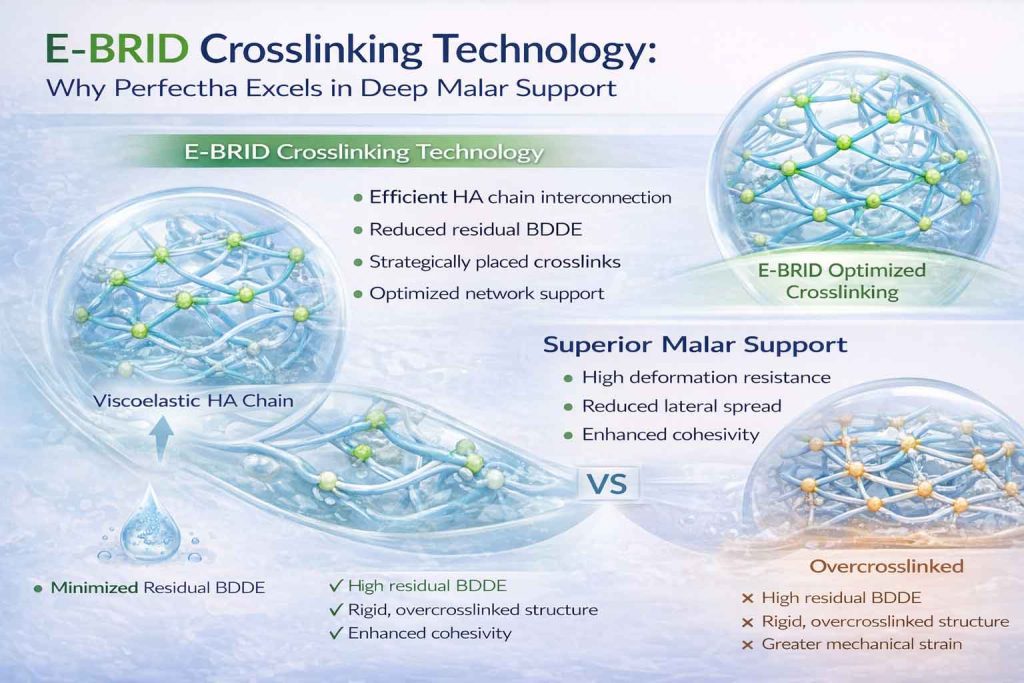
E-BRID (Efficient Biphasic Reticulated Injection Device) technology is based on the principle of maximizing structural integrity while minimizing unnecessary chemical load.
Key characteristics include:
- Optimized HA chain interconnection
- Uniform distribution of crosslinking points
- Reduced need for excessive BDDE
- Stable gel architecture under mechanical stress
Rather than relying on very high crosslinking density, E-BRID focuses on intelligent crosslink placement, resulting in a gel that is both elastic and cohesive.
BDDE: quantity vs efficiency
One of the most overlooked aspects of filler safety and performance is residual BDDE.
While BDDE is necessary for crosslinking, excessive amounts can:
- Increase inflammatory response
- Affect tissue integration
- Contribute to long-term stiffness
E-BRID technology allows Perfectha fillers to achieve high G′ and strong support with lower residual BDDE, improving both biocompatibility and mechanical behavior.
This is particularly important in deep malar injections, where long-term tissue interaction is critical.
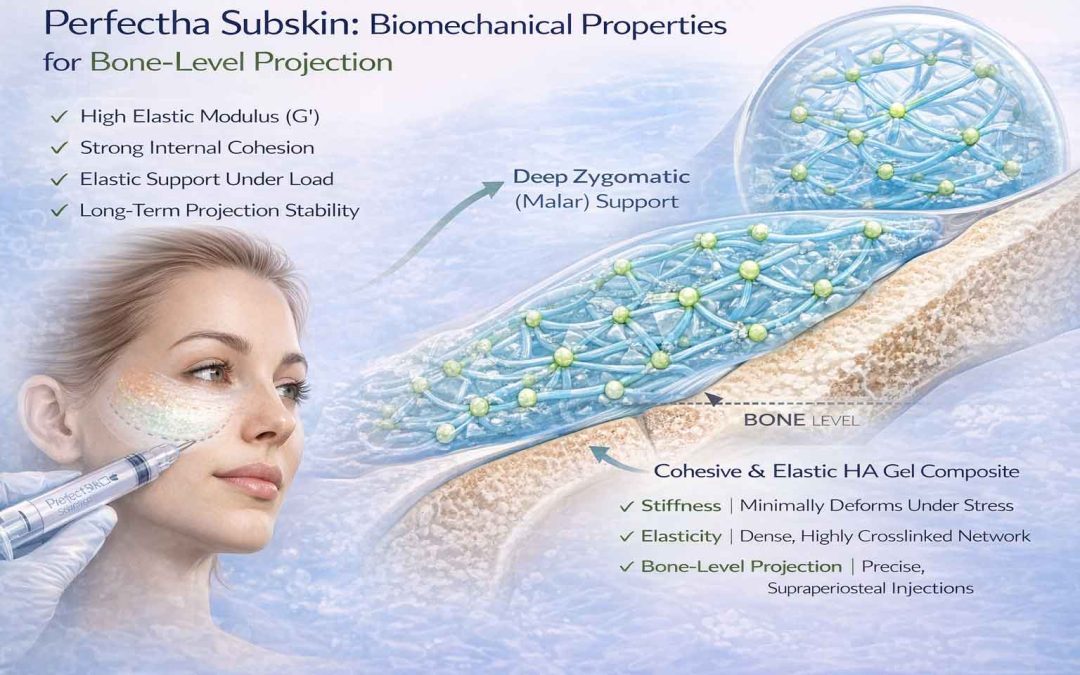
Perfectha Subskin: engineered for deep malar projection
Among the Perfectha range, Perfectha Subskin is specifically designed for deep structural support and bone-level projection.
Key rheological properties
- High elastic modulus (G′)
- Strong resistance to deformation
- High cohesivity
- Low tendency to spread
These properties make it particularly suitable for:
- Deep malar augmentation
- Zygomatic projection
- Structural facial support
- Correction of skeletal volume loss
G′ and deformation resistance: why Perfectha behaves differently
In dynamic facial areas, G′ alone is not sufficient. What truly matters is how the gel responds to repeated mechanical stress.
Perfectha Subskin demonstrates:
- High resistance to compressive forces
- Minimal loss of projection over time
- Stable positioning under movement
This behavior is a direct result of the E-BRID crosslinking architecture, which distributes stress evenly across the gel network instead of concentrating it at weak points.
Cohesivity: the missing link in deep malar fillers
Cohesivity determines whether a filler:
- Maintains its shape
- Integrates predictably
- Resists fragmentation under pressure
Perfectha fillers exhibit high internal cohesivity, meaning the gel behaves as a unified structure rather than dispersing within the tissue.
In deep malar support, this translates into:
- Sharper contours
- Reduced migration risk
- More predictable aesthetic outcomes
Perfectha vs conventional deep fillers: structural comparison
| Parameter | Perfectha Subskin | Conventional High-G′ Fillers |
|---|---|---|
| Crosslinking approach | E-BRID optimized network | High-density crosslinking |
| Residual BDDE | Lower | Often higher |
| Deformation resistance | Very high | Variable |
| Cohesivity | High | Moderate to high |
| Projection stability | Excellent | Variable |
| Tissue integration | Smooth and controlled | Sometimes rigid |
This comparison highlights why crosslinking efficiency matters more than brute force crosslinking.
Clinical implications in malar support
From a practical standpoint, using Perfectha Subskin in the malar region allows:
- Smaller injected volumes
- Better control of projection
- Reduced risk of overcorrection
- Natural interaction with facial dynamics
This aligns with modern aesthetic principles, where precision outweighs quantity.
Injection technique considerations
While product choice is crucial, technique remains fundamental.
Recommended approach for deep malar support with Perfectha:
- Deep supraperiosteal placement
- Small bolus or linear threading
- Conservative volume strategy
- Bilateral symmetry assessment
The structural properties of Perfectha allow the injector to work with the anatomy rather than against it.
Limitations and realistic expectations
No filler is universally superior. Patient anatomy, aging patterns and injector skill always influence outcomes.
Perfectha and E-BRID technology should be viewed as:
- A structural solution for deep support
- Not a universal filler for all indications
- Part of a broader treatment strategy
Conclusion: E-BRID is about intelligent structure, not excess chemistry
The strength of Perfectha does not lie in extreme crosslinking or marketing claims, but in engineering efficiency.
By optimizing crosslinking architecture through E-BRID technology, Perfectha achieves:
- High deformation resistance
- Strong deep malar support
- Lower residual BDDE
- Predictable, stable projection
For physicians focused on structural precision and long-term outcomes, Perfectha Subskin represents a technically sound option for deep malar support.
Manufacturer information and official references
Sinclair is an international aesthetic company specializing in medical devices and injectable solutions with a strong focus on scientific development.