

In recent years, intimate aesthetic medicine has undergone a remarkable expansion. Procedures that once belonged exclusively to reconstructive gynecology have become part of the daily practice of aesthetic physicians. Among them, treatments aimed at improving vulvovaginal quality of life now occupy a significant place, driven by a growing demand from women experiencing dryness, discomfort, or structural changes associated with age, hormonal shifts, postpartum periods, or weight fluctuations. In this context, the interest in Desirial injection protocol, Desirial vs Desirial Plus has increased substantially, as practitioners seek reliable, evidence-based methods to address both functional and structural concerns in the vulvovaginal area.
Within this landscape, Desirial and Desirial Plus have emerged as two of the most widely used formulations of cross-linked hyaluronic acid specifically designed for the vulvovaginal region. Although both products share a similar foundation, their clinical applications differ clearly. One is aimed at improving mucosal hydration and elasticity, the other at correcting volume loss and architectural changes of the labia majora.
Many practitioners use Desirial routinely, yet few references provide a detailed, technical comparison of the two versions or guidance on how to integrate them into a structured clinical protocol. This article outlines a practical approach for medical professionals who wish to apply Desirial safely and effectively, particularly when treating mucosal atrophy or labia majora hypotrophy, which are two of the most frequent reasons for consultation.
1. The Basis for Using Hyaluronic Acid in Intimate Aesthetics
Hyaluronic acid is naturally present in the extracellular matrix. Its use in genital rejuvenation is not simply aesthetic; it provides functional benefits that directly influence comfort, protection and sexual health.
Tissue hydration
By retaining large amounts of water, HA helps restore mucosal elasticity and thickness. This is particularly relevant for patients presenting with menopausal or postpartum dryness.
Structural support
Cross-linked HA can reconstitute lost volume in the labia majora, enhance coverage of the labia minora and reduce mechanical irritation.
Regenerative activity
Desirial includes mannitol, an antioxidant that slows HA degradation and moderates inflammation, which contributes to better tissue integration.
2. Desirial and Desirial Plus: How They Differ and When to Use Each
Although the two formulations share a similar profile, their rheology and indications diverge enough to require deliberate selection.
Comparative overview
| Feature | Desirial | Desirial Plus |
|---|---|---|
| HA concentration | ~19 mg/ml | ~21 mg/ml |
| Cross-linking level | Moderate | Higher |
| Viscosity | Medium | High |
| Main indication | Mucosal atrophy and dryness | Volume restoration of labia majora |
| Recommended injection plane | Superficial dermis or submucosa | Deep subcutaneous |
| Typical volume | 1–2 ml | 2–6 ml |
| Duration | 6–12 months | 9–18 months |
In simple terms:
- Desirial improves the quality of the mucosa.
- Desirial Plus restores volume and external protection.
3. Clinical Diagnosis: Identifying the Indication
Accurate diagnosis is the cornerstone of correct product selection.
Mucosal atrophy
A common complaint among peri- and postmenopausal women, also present in those experiencing hormonal suppression or breastfeeding.
Typical features:
Dryness, burning, pain during intercourse, thinning and pallor of the mucosa.
Product of choice: Desirial.
Labia majora hypotrophy
Frequently related to weight loss, aging or postpartum changes.
Typical features:
Reduced cushioning, visible exposure of the labia minora, discomfort from friction, loss of contour.
Product of choice: Desirial Plus.
Pseudo-hypertrophy
Some patients appear to have enlarged labia majora when in reality the issue is loss of uniform volume or contour irregularity. In such cases, subtle correction with HA can improve symmetry.
4. Pre-Treatment Assessment
Before choosing an injection plan, the practitioner should assess:
Medical history
Hormonal status, prior procedures, recurrent infections, dyspareunia, previous use of energy-based devices.
Physical examination
Evaluate mucosal trophism, depth of the interlabial sulcus, distribution of subcutaneous fat, symmetry and laxity.
Diagnostic tools
FSFI score for sexual function and VAS scales for dryness or pain are useful for documenting baseline status.
Contraindications
Include pregnancy, active infections, poorly controlled autoimmune diseases or hypersensitivity to components of the formulation.
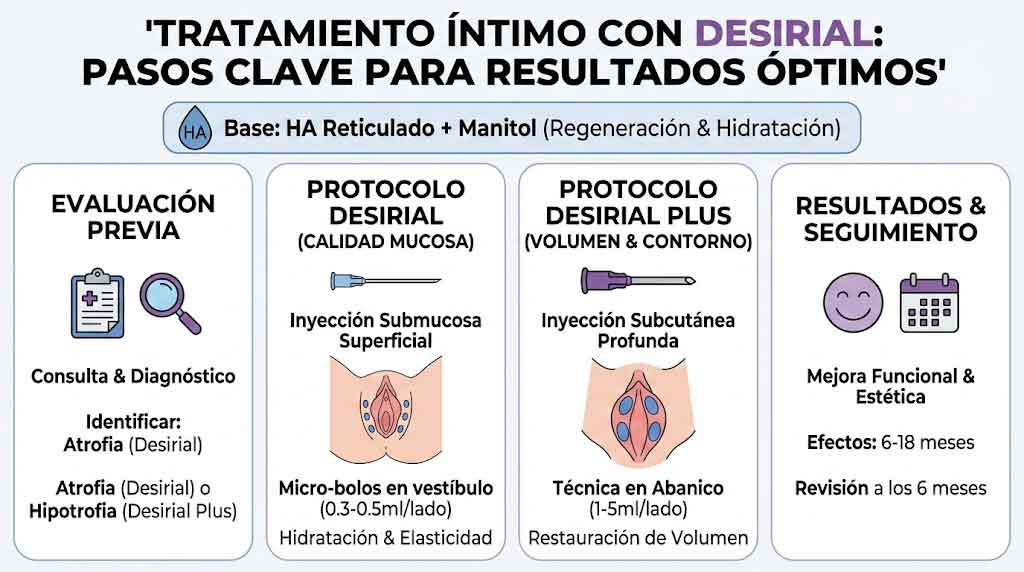
5. Desirial Injection Protocol for Mucosal Atrophy
This protocol focuses on improving mucosal hydration and resilience.
Objective
Enhance lubrication, elasticity and epithelial thickness in the vulvar and vestibular area.
Material
Desirial 1 ml syringe, 30G needle or 25G cannula, antiseptic solution, sterile gauze.
Technique
Preferred method: Cannula 25G in the submucosal plane.
Step-by-step procedure
- Cleanse the area with antiseptic.
- Apply topical anesthetic if needed.
- Create a small lateral entry point.
- Insert the cannula and distribute micro-boluses (0.05–0.1 ml).
- Treat the vestibule, posterior commissure and base of the labia minora.
- Perform gentle molding to ensure even distribution.
Volume guide
| Area | Typical volume per side |
|---|---|
| Vestibule | 0.3–0.5 ml |
| Posterior commissure | ~0.2 ml |
| Base of labia minora | 0.2–0.3 ml |
Total: Usually 1–2 ml.
Follow-up
A single session often provides significant relief, but a booster at six months can be considered depending on symptom recurrence.
6. Desirial Plus Injection Protocol for Labia Majora Hypotrophy
Objective
Restore volume, improve contour, and reinforce protection of the internal genital structures.
Material
Desirial Plus, cannula 22G or 25G, antiseptic, marking pencil.
Anatomical considerations
The injection should remain within the deep subcutaneous compartment. Staying superficial risks contour irregularities; going too deep risks vascular complications.
Technique
Entry point
Usually lateral and low on the labium to avoid major vessels.
Step-by-step
- Insert the cannula into the deep subcutaneous tissue.
- Perform a fan technique to cover the entire labial length.
- Deposit small boluses (0.2–0.3 ml) while withdrawing.
- Shape the labium gently with the fingers.
Volume guide
| Degree of hypotrophy | Volume per side |
|---|---|
| Mild | 1–1.5 ml |
| Moderate | 2–3 ml |
| Severe | 4–5 ml |
Expected outcome
Fuller and better-defined labia majora, improved coverage of the labia minora, and reduced mechanical irritation.
7. Combined Treatment: Structural + Functional Approach
Many women present with both mucosal atrophy and volume loss.
Recommended sequence
- Desirial Plus first, to rebuild the external framework.
- Desirial second, to optimize mucosal quality.
Interval
Both products can be applied in the same session when clinically appropriate, or spaced one week apart.
Benefits observed in clinical practice
Improved lubrication, reduction in discomfort during intercourse, enhanced sexual confidence, and an overall improvement in functional and aesthetic parameters.
8. Adverse Events and Their Management
Although complications are uncommon when performed by trained professionals, it is essential to know how to manage them.
Immediate effects
| Event | Action |
|---|---|
| Edema | Cool compresses |
| Mild discomfort | Analgesics |
| Redness | Observation |
Delayed effects
| Complication | Cause | Approach |
|---|---|---|
| Asymmetry | Uneven distribution | Manual correction or touch-up |
| Nodule formation | Excessive bolus | Hyaluronidase |
| Infection | Inadequate antisepsis | Antibiotic therapy |
9. Scientific Evidence and Safety Considerations
Mucosal compatibility
Hyaluronic acid demonstrates excellent integration into mucosal tissues with minimal migration and a favorable safety profile.
Effectiveness in menopausal symptoms
Clinical studies highlight measurable improvements in hydration, pH balance, mucosal thickening and sexual comfort after Desirial treatment.
Combination with energy-based devices
Desirial works well alongside laser therapy or radiofrequency, either before or after treatment, depending on the clinical objective.
10. Frequently Asked Questions
How long does the effect last?
Desirial typically lasts 6–12 months, whereas Desirial Plus can persist for 9–18 months.
Can hyaluronidase be used?
Yes, although with caution in mucosal areas.
Is anesthesia necessary?
Topical anesthesia is often sufficient. For sensitive patients, a pudendal block may be considered.
11. Conclusion
Desirial and Desirial Plus provide two distinct but complementary solutions in intimate aesthetic medicine. Desirial addresses mucosal quality and hydration, while Desirial Plus is designed for volume restoration and contour correction of the labia majora.
A clear understanding of each product’s rheology and indication ensures predictable results and enhances patient satisfaction. As demand for intimate rejuvenation continues to grow, mastering these protocols helps practitioners deliver safe, evidence-based and functionally meaningful outcomes.
Official Sources
https://www.vivacy.com
https://www.ema.europa.eu
https://clinicaltrials.gov