
A Technical Guide to Superficial Intradermal Correction of Fine Lines Without Tyndall Effect
The correction of superficial facial wrinkles remains one of the most technically demanding procedures in aesthetic medicine. For this reason, the Belotero Soft blanching technique has become a key reference when addressing superficial indications, where injection depth, product behavior, and dermal integration must be precisely controlled to avoid visible irregularities.
Unlike volumetric corrections, superficial indications leave little margin for error. Injection depth, product behavior, and dermal integration must be precisely controlled to avoid visible irregularities.
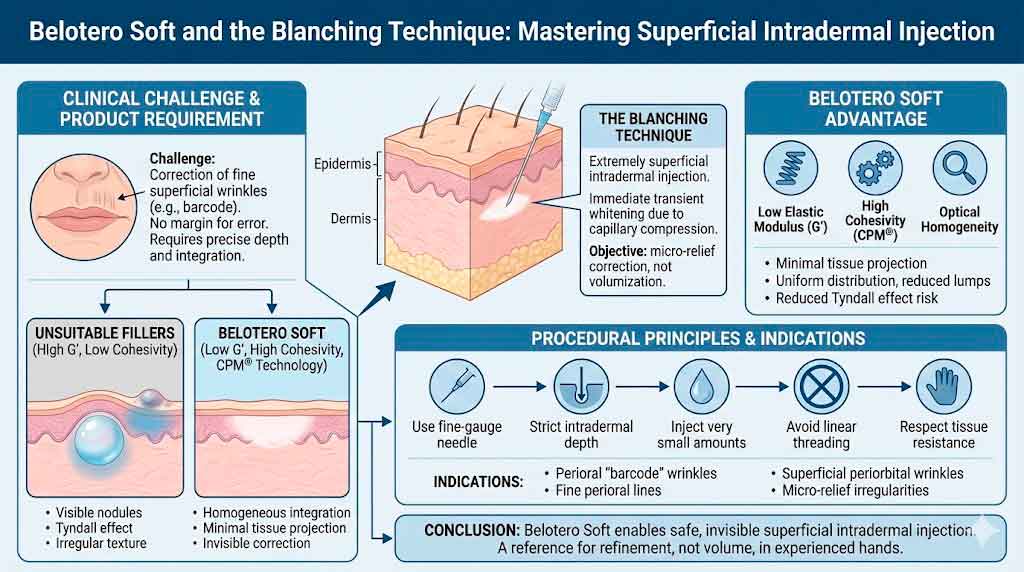
The blanching technique has become a reference approach for the treatment of fine superficial lines, particularly perioral “barcode” wrinkles. This technique relies on extremely superficial intradermal injections and is therefore highly dependent on the physical properties of the filler used. When performed with inappropriate gels, blanching may result in Tyndall effect, visible nodules, or uneven skin texture.
In this context, Belotero Soft, developed by Merz Aesthetics, has established itself as a reference product for superficial intradermal correction.
The blanching technique: principles and objectives
The blanching technique consists of injecting very small amounts of hyaluronic acid into the superficial dermis, producing an immediate, transient whitening of the skin caused by capillary compression.
The primary objective is surface refinement, not volume replacement.
Key technical characteristics
- Injection depth: very superficial intradermal
- Volume per injection point: minimal
- Needle angle: almost parallel to the skin
- Injection pattern: point-by-point micro-deposits
Because of this superficial placement, only fillers with excellent dermal integration and optical homogeneity are suitable for this technique.
Why Belotero Soft is suitable for blanching
Belotero Soft is formulated using Cohesive Polydensified Matrix (CPM®) technology, which gives the gel a unique combination of high cohesivity and low elastic modulus (G’). This allows the product to integrate homogeneously within the dermis without creating visible projections.
Relevant rheological characteristics
| Property | Clinical relevance |
|---|---|
| Low G’ | Minimal lifting effect, no overcorrection |
| High cohesivity | Uniform distribution within the dermis |
| High tissue integration | Invisible correction at superficial depth |
| Optical homogeneity | Reduced risk of Tyndall effect |
These properties explain why Belotero Soft can be injected at depths where other hyaluronic acid fillers would become visible or palpable.
Clinical indications
Although best known for perioral barcode wrinkles, the blanching technique with Belotero Soft can also be applied to:
- Fine perioral lines
- Superficial periorbital wrinkles
- Micro-relief irregularities
- Selected superficial facial lines
All these indications share a common requirement: improving skin surface quality without altering facial volume or expression.
Blanching technique in clinical practice
Successful blanching depends more on technical precision than on injection force or volume.
Practical considerations
- Use a fine-gauge needle
- Maintain strict intradermal depth
- Inject very small aliquots per point
- Avoid linear threading techniques
- Respect tissue resistance and skin thickness
The blanching effect should resolve within minutes, leaving a smooth, uniform skin surface without visible product accumulation.
Why blanching fails with other fillers
A common misconception is that blanching is purely a matter of technique. In reality, product selection is equally critical.
Fillers with higher projection capacity, lower cohesivity, or heterogeneous particle distribution tend to produce:
- Bluish discoloration (Tyndall effect)
- Persistent papules
- Visible nodules in thin skin
Belotero Soft’s formulation significantly reduces these risks when used correctly.
Safety considerations
As with all superficial intradermal techniques:
- Detailed anatomical knowledge is essential
- Conservative dosing is mandatory
- Blanching should be avoided in compromised or inflamed skin
When performed with appropriate patient selection and technique, blanching with Belotero Soft has a favorable safety profile and high patient satisfaction.
Clinical differentiation and positioning
While Belotero products are often discussed in comparative terms, specific guidance on the blanching technique remains limited. This creates a clear opportunity to position Belotero Soft as a premium solution for superficial intradermal correction, rather than as a general-purpose soft filler.
Conclusion
The blanching technique represents an advanced intradermal skill where both technique and filler properties determine success.
Thanks to its high cohesivity, low elastic modulus, and superior dermal integration, Belotero Soft allows practitioners to safely perform extremely superficial intradermal injections with a level of control and invisibility that most hyaluronic acid gels cannot achieve.
For experienced practitioners treating perioral barcode wrinkles and fine superficial lines, Belotero Soft remains a reference product when the clinical objective is refinement rather than volume.
Official sources and references
The technical and clinical information presented in this article is based on manufacturer documentation, regulatory frameworks, and peer-reviewed scientific literature relevant to superficial intradermal injection techniques and hyaluronic acid fillers.
Manufacturer and official documentation
- Merz Aesthetics – Official website
https://merz-aesthetics.com - Belotero® product range – Scientific and technical information
https://belotero.com
Medical device regulation and safety
- European Commission – Medical Device Regulation (MDR)
https://health.ec.europa.eu/medical-devices-sector/overview-medical-devices_en - European Medicines Agency (EMA)
https://www.ema.europa.eu
Scientific and clinical literature
- National Center for Biotechnology Information (NCBI / PubMed)
https://pubmed.ncbi.nlm.nih.gov - Journal of Cosmetic Dermatology
https://onlinelibrary.wiley.com/journal/14732165 - Aesthetic Plastic Surgery (Springer Nature)
https://link.springer.com/journal/266